
Fieldworker App: Real-Time Notifications & Alerts
OctopusPro’s real-time notifications help fieldworkers stay on top of job requests, booking assignments, schedule changes, and messages—so nothing gets missed when you’re on the road or on-site.
You’ll learn: what notifications are, which channels OctopusPro can use (push, in-app, SMS, email), what commonly triggers alerts, how fieldworkers can manage notifications in the app, and what admins can configure to keep alerts useful (not noisy).

Table of contents
- What real-time notifications are
- Where notifications appear (push, in-app, badges)
- Notification channels (Push, In-app, SMS, Email)
- Common notification triggers
- Fieldworker: view & manage notifications
- Admin: configure notification settings
- Best practices
- Troubleshooting
- FAQs
- Related guides
What real-time notifications are
Real-time notifications are instant alerts sent when something important changes—such as a new job request, a booking being assigned, a reschedule, a cancellation, or a new message. They help your team react quickly and keep the day running smoothly.
Why it matters:
- Fewer missed jobs: fieldworkers see new assignments and changes immediately.
- Faster response times: urgent work and last-minute changes reach the right person quickly.
- Less back-and-forth: fewer “What’s my next job?” calls and fewer dispatch follow-ups.
- Better customer experience: smoother arrivals, fewer delays, and quicker communication.
Where notifications appear (push, in-app, badges)
OctopusPro can surface updates in multiple ways so fieldworkers don’t miss critical changes:
- Push notifications on the device (lock screen, banner, notification tray).
- In-app Notifications (a notification inbox/log inside the Fieldworker App).
- Badge counters (unread indicators for new requests, messages, or updates).
Notification channels (how OctopusPro delivers updates)
Depending on your company configuration and the fieldworker’s device settings, OctopusPro can deliver alerts through one or more channels:
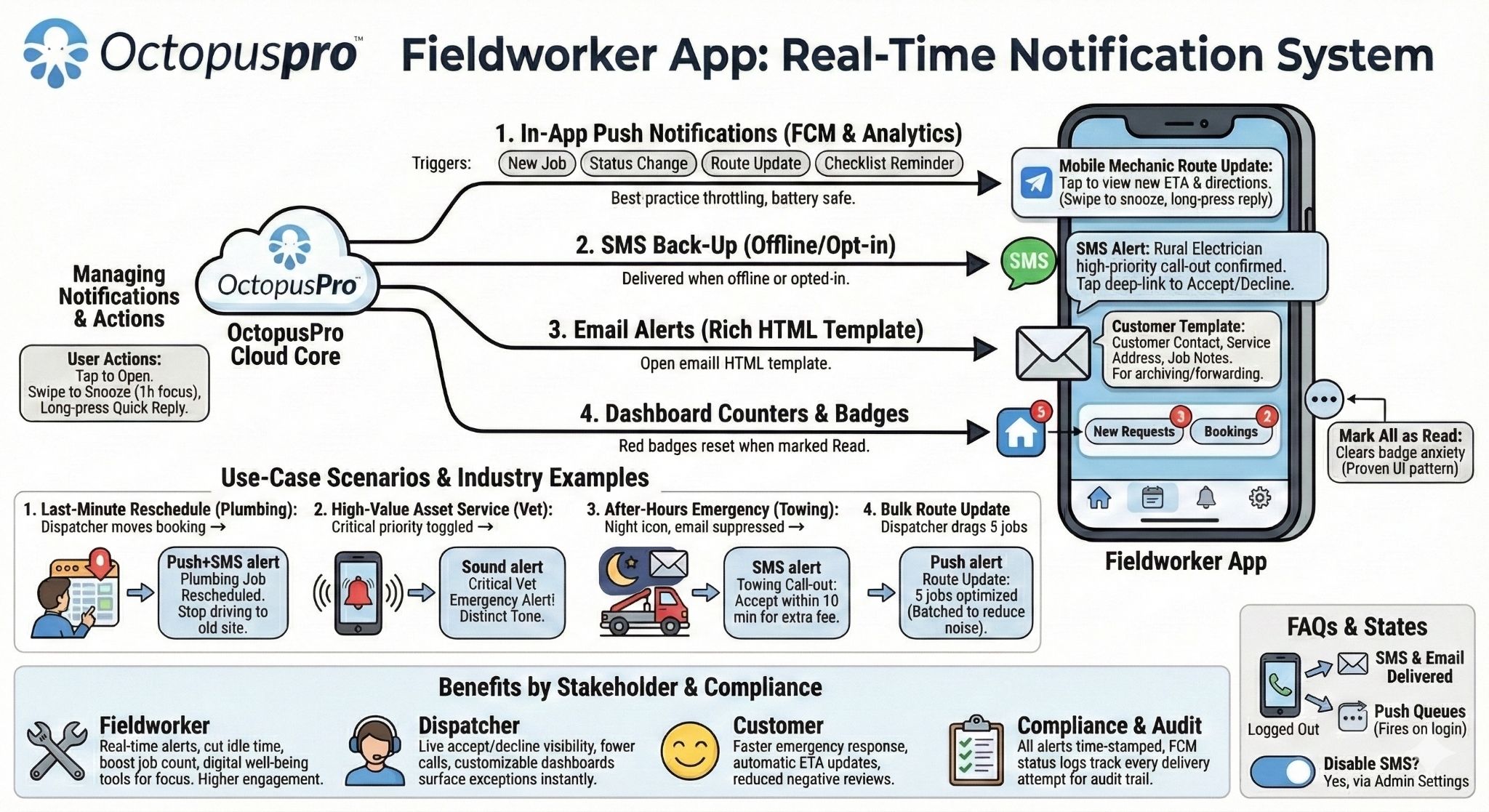
1) Push notifications (mobile)
- Fastest channel for real-time updates on iOS and Android.
- Ideal for job requests, booking assignments, reschedules, cancellations, and urgent messages.
- Typically allows the fieldworker to open the relevant booking or screen quickly from the alert.
2) In-app notifications (Notifications inbox)
- A complete log of alerts inside the Fieldworker App.
- Useful when a push notification was missed due to Do Not Disturb, poor signal, or battery restrictions.
- Great for reviewing updates later and clearing unread counters.
3) SMS alerts (optional)
- Best used as a backup channel for urgent updates.
- Availability depends on your account settings and SMS configuration (and may incur messaging costs).
4) Email alerts
- Often used for office workflows, archiving, or when a fieldworker prefers email as a secondary channel.
- May include job details depending on fieldworker permissions and what your company enables.
5) Badge counters & indicators
- Unread counters can highlight new job requests, messages, or updates.
- Counters typically clear when notifications are marked as read and/or items are actioned.
Common notification triggers
Fieldworkers commonly receive notifications for events such as:
- New job requests (when your company allows Accept/Decline workflows).
- Booking assigned or reassigned to a fieldworker.
- Schedule changes (reschedules, cancellations, date/time changes).
- Booking detail updates (address changes, service changes, updated notes/instructions).
- New messages (from office staff and/or customers, depending on settings).
- Reminders (upcoming jobs, ETA/arrival prompts, and other alerts where enabled).

Job-request and assignment behaviour depends on your dispatch setup and fieldworker permissions. To learn more, see Managing New Job Requests and Booking Assignments and Job Assignment & Dispatch (Manual vs Automated).

Fieldworker: view & manage notifications
View your notifications in the Fieldworker App
Open the Notifications section in the Fieldworker App to view all alerts in one place. This is the best place to check if you think you missed a push notification.
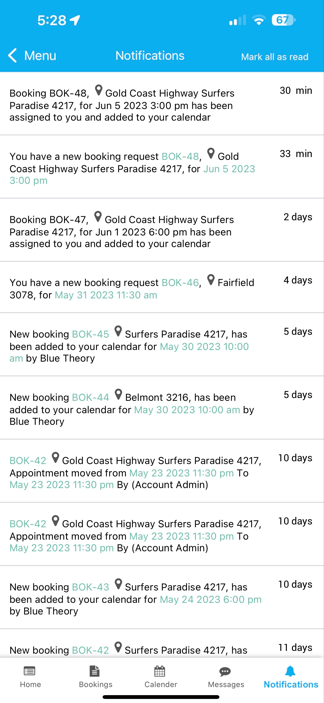
- Tap a notification to open the related booking, request, or message.
- Use Mark all as read to clear unread indicators once you’ve reviewed updates.
Enable notifications on your phone (required for push alerts)
Push notifications require both (1) your company settings to allow the alert, and (2) your device to allow OctopusPro notifications.
- iPhone (iOS): Settings → Notifications → OctopusPro → enable Allow Notifications, then choose your preferred alert styles (Lock Screen, Notification Center, Banners).
- Android: Settings → Apps → OctopusPro → Notifications → enable notifications (and any available notification categories/channels).
Tip: If you don’t want sensitive details on your lock screen, adjust your device notification preview settings (e.g., “Hide content” or “Show previews when unlocked”).
Check battery & background restrictions (Android especially)
Some devices delay or block notifications when battery saver or background restrictions are enabled. If you’re not receiving alerts reliably, try disabling battery optimisation for OctopusPro.
Admin: configure notification settings
Admins can control which events trigger alerts, which channels are used (push/SMS/email), and who receives each notification. This helps you send the right alerts to the right people while avoiding notification fatigue.
For admin setup and configuration options, see Notifications, Discussions, Call & SMS Alerts.

If notification content includes customer contact details or job addresses, visibility may depend on access control settings. See Fieldworker Permissions & Access Control.
Best practices
- Keep alerts actionable: prioritize notifications that require attention (new assignment, reschedule, urgent message) and avoid enabling every low-priority event.
- Use reminders for punctuality: combine notifications with alarms and reminders for upcoming bookings and ETA prompts.
- Reserve SMS for critical updates: use SMS as a fallback for emergencies or high-priority jobs.
- Align notifications with dispatch workflows: if fieldworkers accept/decline jobs, ensure job-request alerts are enabled and clear.
Learn more about reminders in Alarms, ETA Alerts & Booking Reminders.

Troubleshooting
I’m not receiving push notifications
- Check device permissions: confirm OctopusPro notifications are allowed in iOS/Android settings.
- Check Do Not Disturb / Focus mode: these modes can silence or delay notifications.
- Check connectivity: poor signal can delay delivery until the device reconnects.
- Check battery restrictions: disable aggressive battery saving for OctopusPro (especially on Android).
- Check the in-app Notifications inbox: even if a push was missed, the alert may still appear in-app.
We’re getting too many notifications
- Review the enabled notification triggers in admin settings and disable non-essential alerts.
- Use alarms/reminders instead of frequent manual messages for routine prompts.
- Keep SMS limited to urgent/high-priority updates.
FAQs
What if the fieldworker is logged out of the app?
Delivery depends on your configuration. Email and SMS (if enabled) may still deliver updates. Push notifications generally require the app to be installed and device notifications enabled.
Can we keep push notifications but disable SMS?
Yes. SMS is optional and can typically be enabled/disabled in admin notification settings (where available).
Why do some fieldworkers receive notifications and others don’t?
This is usually caused by device notification permissions, battery restrictions, Focus/Do Not Disturb, or fieldworker permissions/access rules.
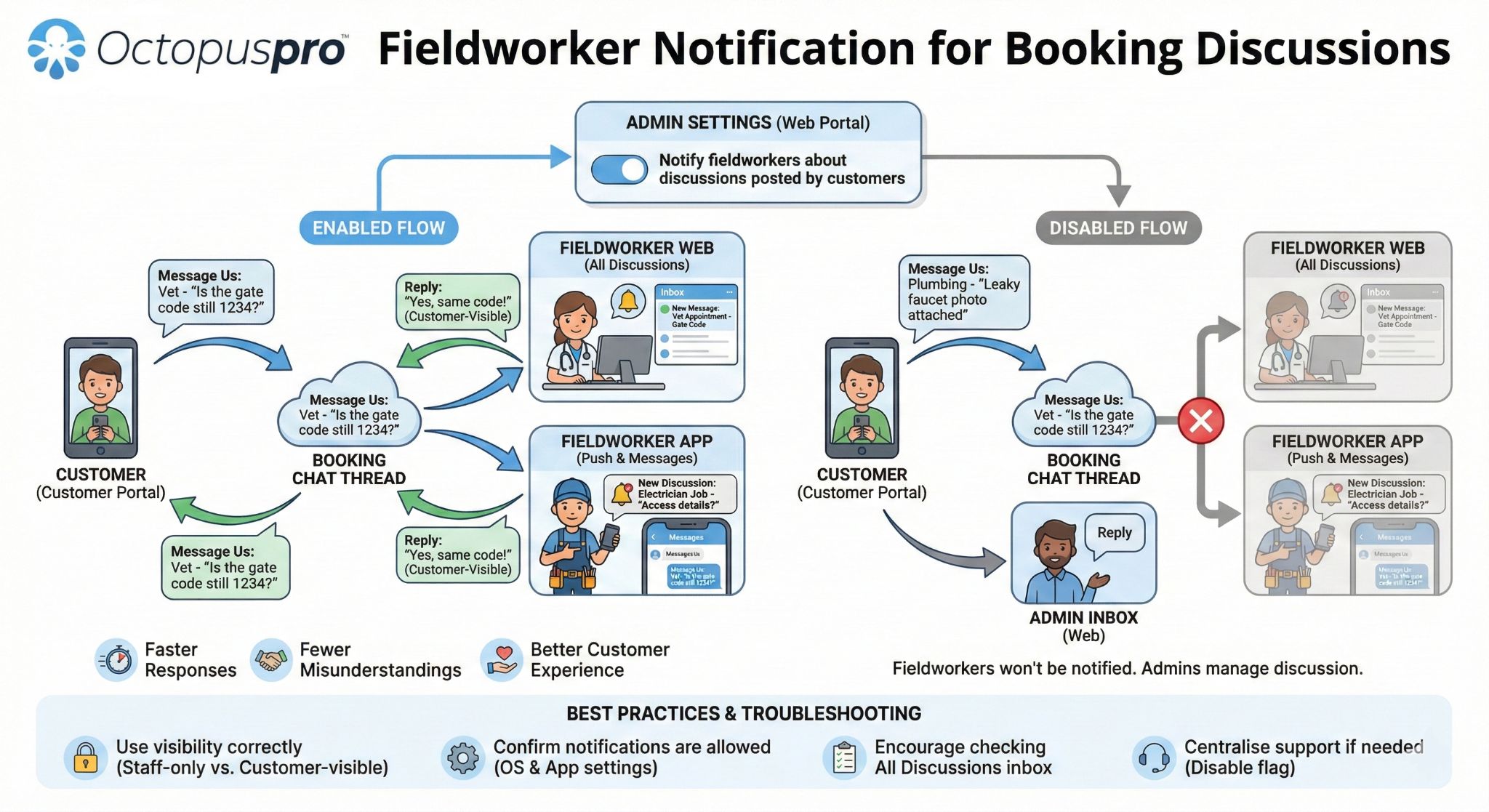
Can fieldworkers be notified about customer messages?
Yes, if your company enables discussion/message notifications. Learn more in Notify Fieldworkers About Booking Discussions and Fieldworker App Communication Guide.

Related guides
- Getting Started as a Fieldworker
- Managing New Job Requests and Booking Assignments
- Allow Fieldworkers to Accept or Decline Job Requests
- Fieldworker App Communication Guide
- Alarms, ETA Alerts & Booking Reminders
- Fieldworker Check-In/Out Tracking & GPS Time Logs
- Notifications, Discussions, Call & SMS Alerts (Admin Setup)
To stay updated, please subscribe to our YouTube channel.