
Activating & Deactivating Users
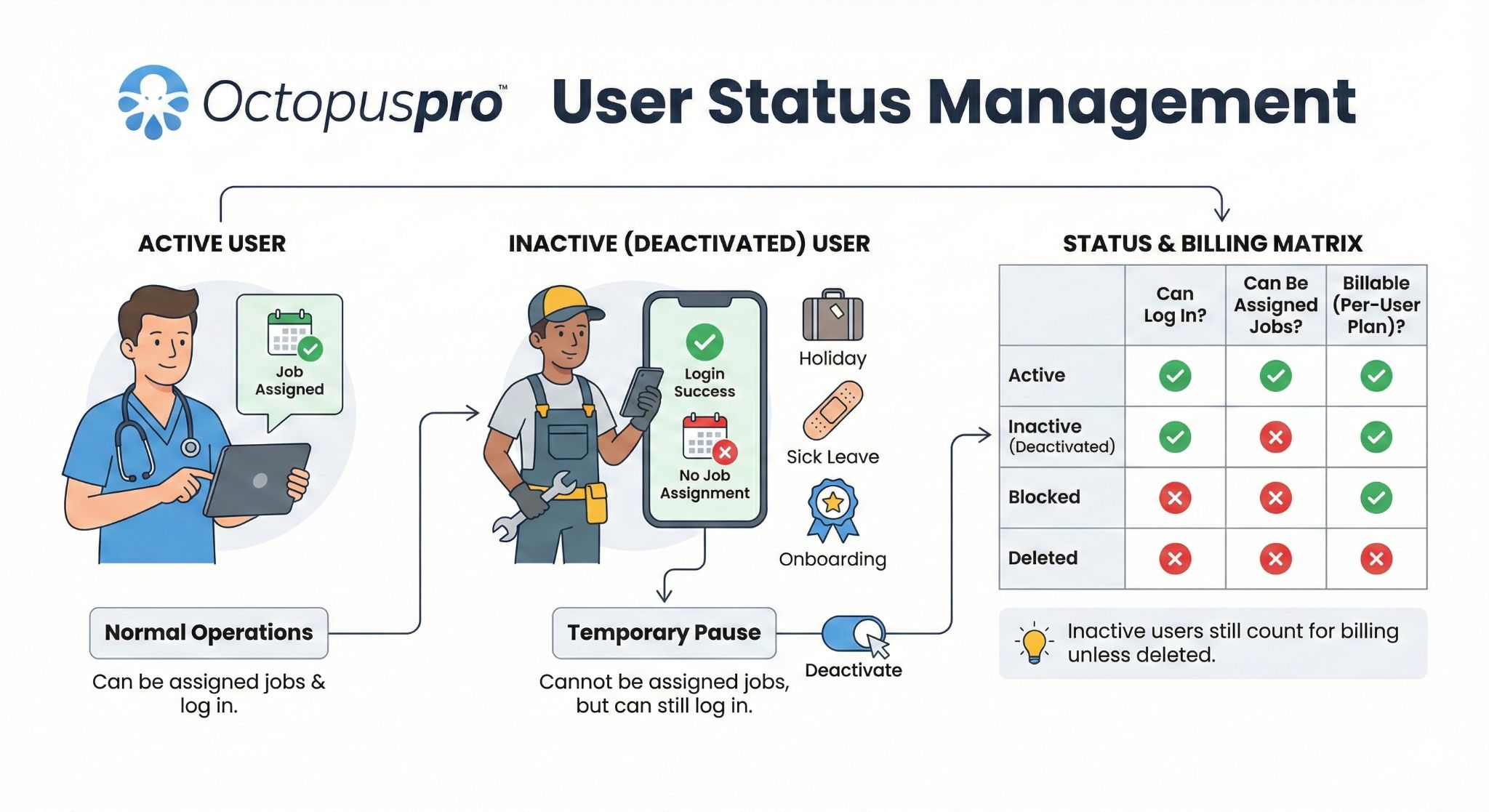
Use Activate and Deactivate to control whether a user is currently “active” in your OctopusPro account. This is ideal for temporary absences, onboarding, seasonal staff, or pausing access without removing historical records.
- Active users can be assigned jobs and work normally (based on their role/permissions).
- Inactive (deactivated) users cannot be assigned jobs, but can still log in and access the system unless you also block them.
On this page
- What activating/deactivating does
- How to activate or deactivate a user
- Billing considerations (per-user plans)
- Best practices (offboarding & return-to-work)
- Active vs Inactive vs Blocked vs Deleted
- Troubleshooting
- Related articles
What activating/deactivating does
Activating or deactivating a user helps you manage access and scheduling without losing the user’s history (bookings, notes, activity logs, etc.).
- Activate to return a user to normal operations (they can be assigned jobs again).
- Deactivate to pause job assignment for that user while keeping their profile and history in your account.
How to activate or deactivate a user
1) Open the Users list
- Go to Settings > Company Settings > Users.
- Use the search and filters to find the user (filter by role, status, or name).
2) Change the user status (Activate / Deactivate)
You can change the status using either method (depending on your screen layout and permissions):
- Actions menu: Click Actions (⋯) next to the user, then select Activate user or Deactivate user.
- Active toggle: If your Users list includes an Active switch, toggle it on/off to quickly activate/deactivate.
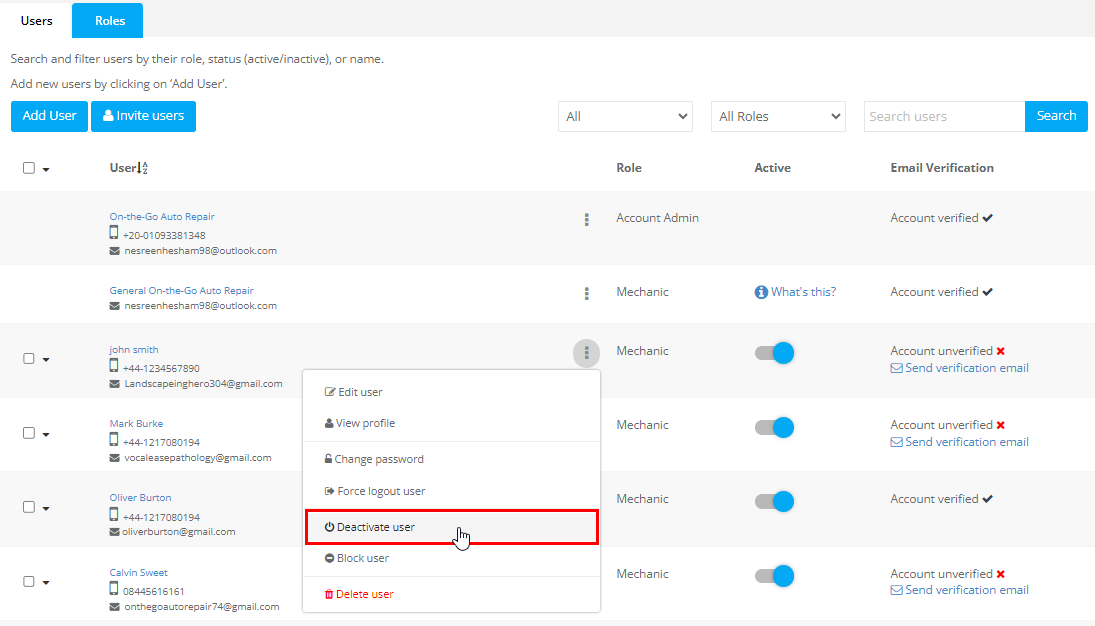
What happens after deactivating?
- The user becomes Inactive.
- They cannot be assigned jobs.
- They can still log in unless you also block the user.
Billing considerations (per-user plans)
Important: If you are on a per-user subscription plan, inactive users still count toward your user count. If you want to avoid charges for users who no longer need access, consider:
- Deleting the user (permanent removal of the user account), or
- Switching to an unlimited users plan (if applicable to your subscription).
Best practices (offboarding & return-to-work)
When deactivating is the right choice
- Temporary leave (holiday, sick leave, parental leave).
- Seasonal/contractor downtime where you expect them to return.
- Onboarding (keep inactive until training is completed).
When you should block or force logout instead
Deactivate is primarily for scheduling control. If you need to restrict access for security or compliance reasons, use one of these options:
- Block user to prevent login entirely.
- Force logout to immediately end an active session (useful if you suspect unauthorised access).
- Change/reset password if credentials may be compromised.
Returning a user to work
- Activate the user again.
- Confirm they still have the correct role & permissions.
- If needed, ask them to log out/in again (or force logout first) to ensure changes take effect.
Active vs Inactive vs Blocked vs Deleted
| Status | Can log in? | Can be assigned jobs? | Best for |
|---|---|---|---|
| Active | Yes | Yes | Normal working access |
| Inactive (Deactivated) | Yes (unless blocked) | No | Temporary pause (leave, onboarding, seasonal) |
| Blocked | No | No | Security restriction / suspended access |
| Deleted | No (account removed) | No | Permanent removal; reduce user count on per-user plans |
Tip: If you manage field teams, see Activate / Deactivate Fieldworkers and Blocking & Unblocking Fieldworker Accounts.
Troubleshooting
I can’t see Activate/Deactivate options
- Confirm your role has the required user management permissions.
- If you are not an admin, ask an administrator to update your role permissions.
The user is still logged in after I deactivated them
Deactivation affects job assignment status, not live sessions. If you need to end their current access immediately, use Force Logout Specific Users or Block user.
Related articles
User & access management
- User Management: Adding, Inviting, Importing Users
- Role-Based Access Control (RBAC) & Permissions
- Changing and Resetting User Passwords
- Login as Another User (User Impersonation)
Security actions
User removal (when you no longer need the account)
To stay updated, please subscribe to our YouTube channel.