
Customer Portal Flags & Permissions (Website, Booking & Fieldworker Controls)
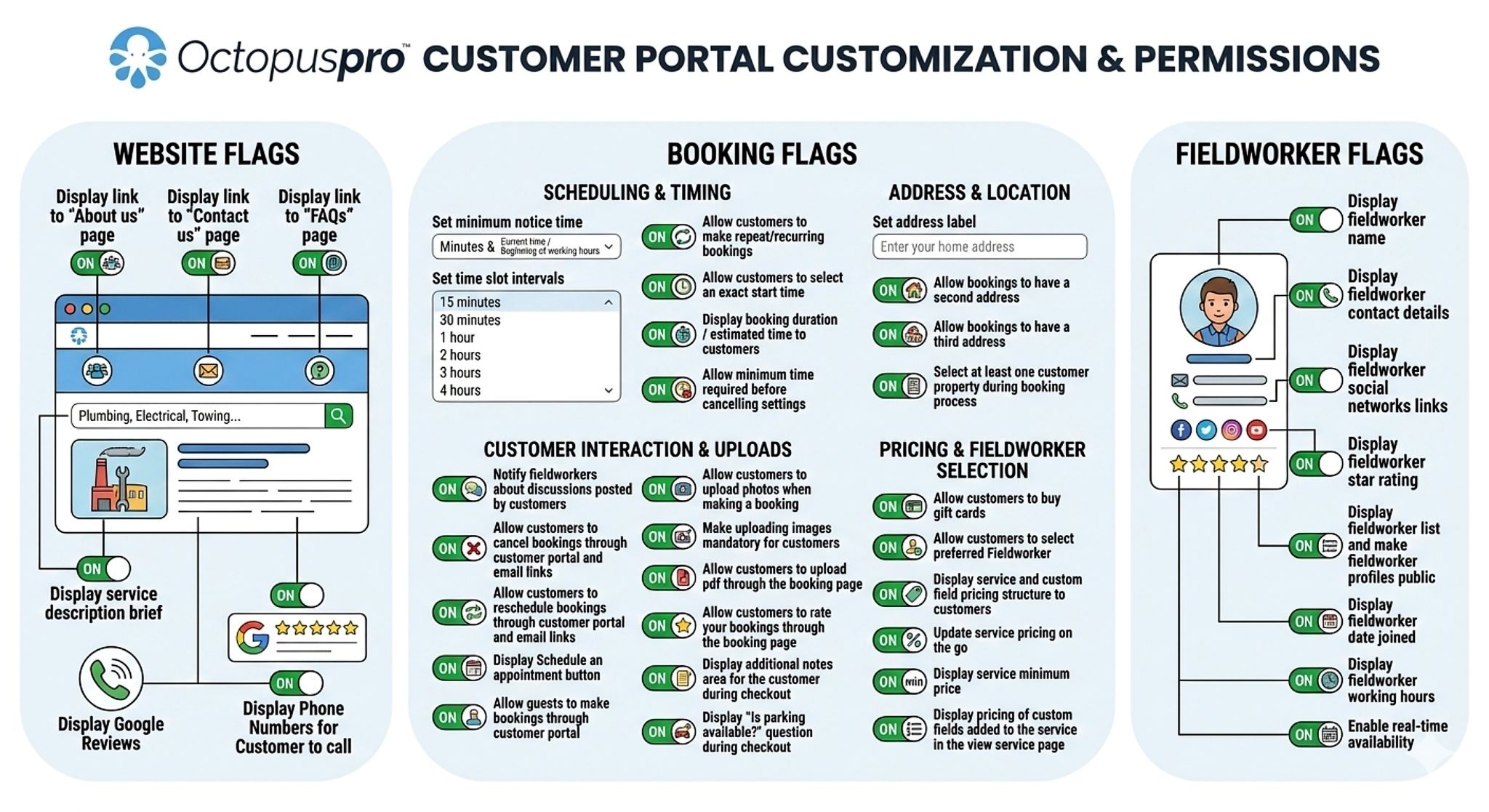
The Customer Portal Flags & Permissions settings let you control what customers can see and do in your Customer Portal—such as self-service booking, cancellation/rescheduling, guest checkout, uploads, pricing visibility, and fieldworker profile visibility.
Path: Settings > Customer Portal > Flags & Permissions
Table of contents
- How flags work (important notes)
- Website Flags (menu, search, reviews, click-to-call)
- Booking Flags (lead time, time slots, addresses, self-service actions, uploads, pricing)
- Fieldworker Flags (profile visibility, ratings, availability, service area validation)
- Troubleshooting & best practices
How flags work (important notes)
- Flags are feature toggles that instantly change what customers can access in the portal once you click Save.
- Some flags have dependencies (for example: fieldworker profiles must be public for customers to view them; service areas must be configured for service area validation to work).
- Test like a customer: open the portal in an incognito/private window after saving changes.
- Emails & links: “Cancel” and “Reschedule” links in emails appear only when the related portal flags are enabled (and your email templates include those links/buttons).
Website Flags
Display link to “About us” page in menu
Enable this to show an About Us link in your Customer Portal top menu. Use it to build trust and reduce pre-booking friction.
Tip: Keep the About page concise: what you do, service areas, warranties/guarantees, and why customers should choose you.
Learn more: Display link to “About us” page in menu
Display link to “Contact us” page in menu
Enable this to show a Contact Us link in the portal menu. This is useful for questions that shouldn’t become bookings (e.g., special requests).

Learn more: Display link to “Contact us” page in menu
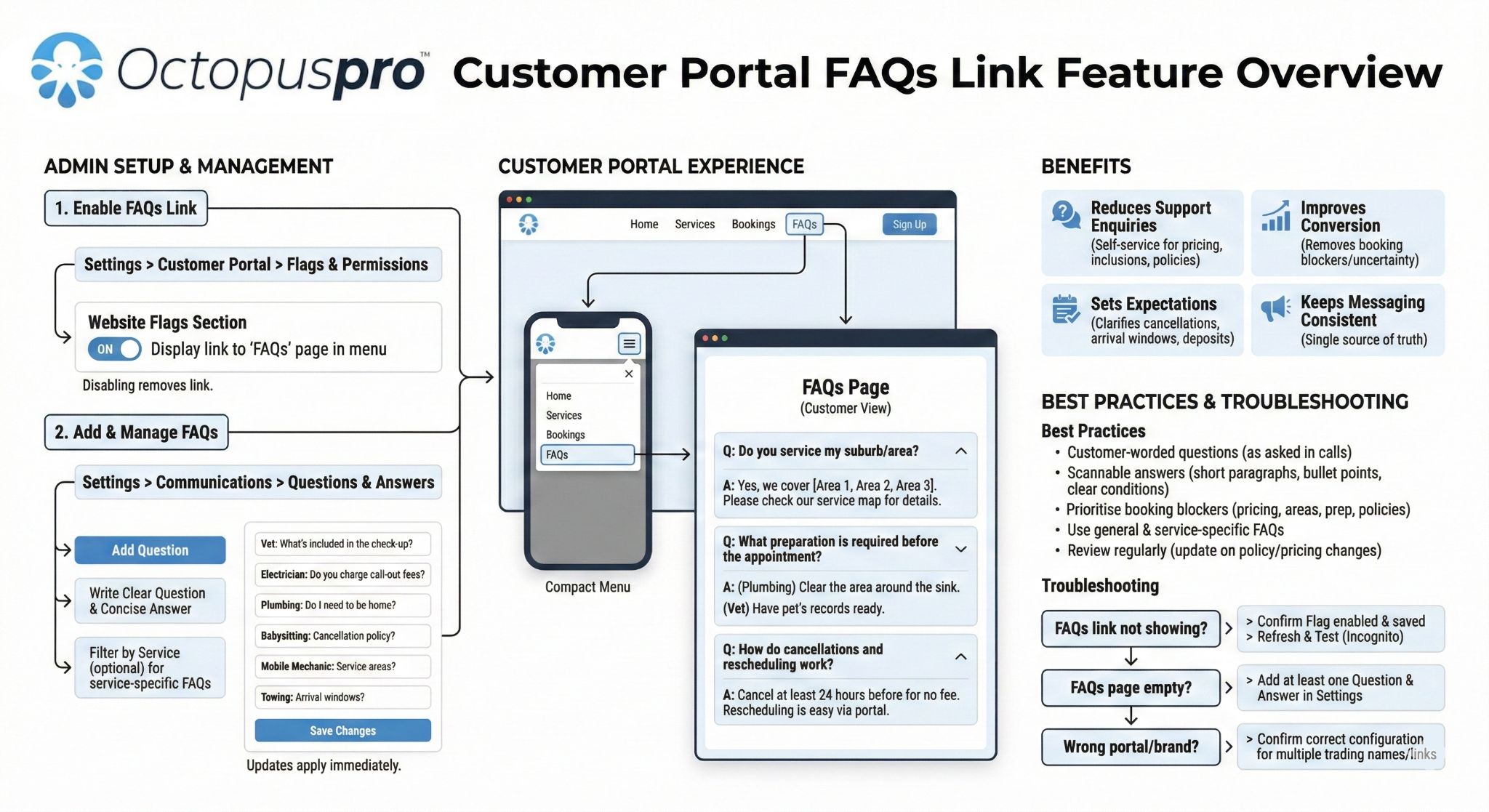
Display link to “FAQs” page in menu
Enable this to show an FAQs link in the portal menu. FAQs reduce support load and improve conversion by answering common objections.
Learn more: Display link to “FAQs” page in menu
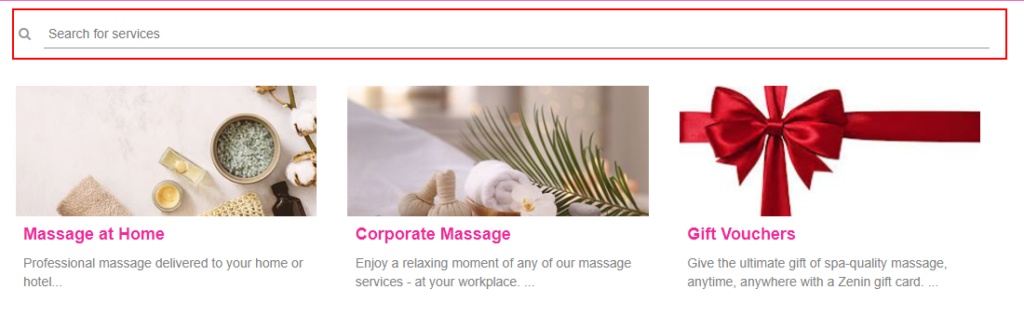
Display a search bar for services in the customer portal
Enable this to add a service search bar so customers can quickly find the right service—especially helpful when you have many categories.
Learn more: Display a search bar for services in the customer portal
Display service description brief in the services list in the customer portal
Enable this to show a short service summary under each service in the service list. This improves clarity and reduces wrong bookings.
Best practice: Keep the brief to 1–2 lines (what’s included + who it’s for).
Display Google Reviews in customer portal homepage
Enable this to display your Google Reviews on the portal homepage to build social proof.

Learn more: Display Google Reviews in customer portal homepage
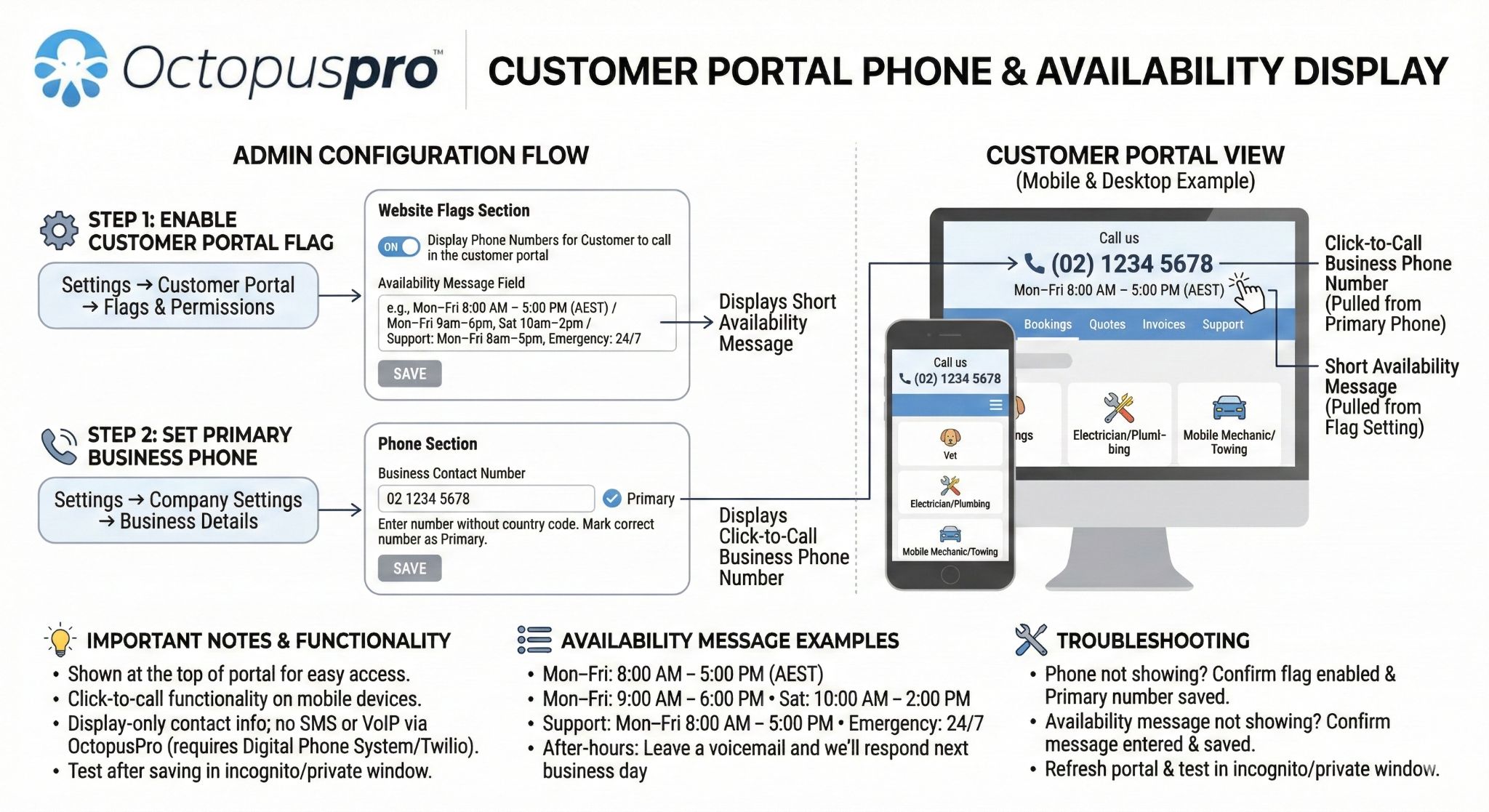
Display Phone Numbers for Customer to call in the customer portal
Enable this to show a click-to-call phone number (and an optional availability/business-hours message) at the top of your portal.
Note: The phone number is typically pulled from Settings > Company Settings > Business Details (Primary phone). You can also add the message shown under the number (e.g., business hours).
Learn more: Customer Portal Phone Number & Business Hours (Click-to-Call)
Booking Flags
What is the minimum notice time required for any new bookings? (X) minutes
This is your minimum lead time (in minutes) before a customer can book an appointment. It prevents last-minute bookings that your team can’t prepare for.
- Example: If you set 60 minutes, customers can only book time slots at least 60 minutes from the reference start time.
- Best practice: Mobile/field services often use 60–180 minutes; clinics/salons often use 15–60 minutes.

Learn more: Minimum Notice Time + “Starting From” Options
Minimum notice time starting from
Choose how OctopusPro calculates the lead-time window:
- Current time (rolling lead time from now)
- Beginning of working hours (consistent “earliest start time” each day, based on working hours)
Time slot intervals
Time slot intervals define the step size between bookable start times (e.g., every 15, 30, or 60 minutes). This keeps customer selections aligned with how you schedule and dispatch.
Example: A 30-minute interval allows start times like 9:00, 9:30, 10:00, etc. (subject to availability and service duration).
Default travel radius
Sets the default service/travel radius used for scheduling/validation when a more specific service area isn’t defined. This helps keep bookings within a workable distance and supports location-based availability.
- Use case: “Default radius = 20 km” so bookings outside the radius can be blocked or flagged for manual review (depending on your workflow).

Related: Fieldworker Service Areas
Long address label & Short address label
These labels control the wording customers see when entering the booking location.
- Long address label (prompt): e.g., “What’s the full address for the booking?”
- Short address label (field label): e.g., “Booking address”
Best practice: If you need extra detail (unit number, access notes), keep the prompt explicit to reduce incomplete addresses.
Allow bookings to have a second address
Enable this to allow customers (and admins) to add a second location to the same booking (e.g., pick-up + drop-off, or two sites).

Learn more: Multi-Address Bookings (Setup + Examples)
Allow bookings to have a third address (if available in your account)
Some accounts may also include a third address option for more complex jobs (e.g., multiple stops). If you see this flag, enabling it will allow an additional address field during booking creation.
Notify fieldworkers about discussions posted by customers
When enabled, fieldworkers receive notifications when customers post messages/comments on a booking discussion thread—improving responsiveness and reducing miscommunication.
Enable customer self-scheduling after quote approval
When enabled, customers can self-schedule a booking time after a quote is approved—typically via a “Schedule an appointment” action/link.
Tip: Ensure your quote emails include the scheduling link/button, and consider enabling real-time availability for conflict-free scheduling.
Allow customers to make repeat/recurring bookings
Enable this to allow customers to create recurring bookings (repeat appointments) through the portal when your services support it.
Generate invoice automatically when the booking is created

When enabled, OctopusPro will auto-create an invoice as soon as the booking is created—useful if you want immediate invoicing, deposit requests, or automated payment workflows.
- Best for: fixed-price services, deposits on booking, or jobs where invoicing must start immediately.
- Consider: If your pricing is confirmed after inspection, you may prefer to keep invoices manual until the scope is verified.
Learn more: Auto-Create Invoices on Portal Bookings
Allow customers to buy gift cards
Enable this to sell gift cards through your portal (great for services like wellness, cleaning packages, or seasonal promotions).
Allow customers to select preferred fieldworker when making a booking
Enable this to allow customers to choose a preferred technician/fieldworker during booking—ideal for repeat customers and relationship-based services.
Important: This usually works best when fieldworker profiles are public and services are assigned to the relevant fieldworkers.
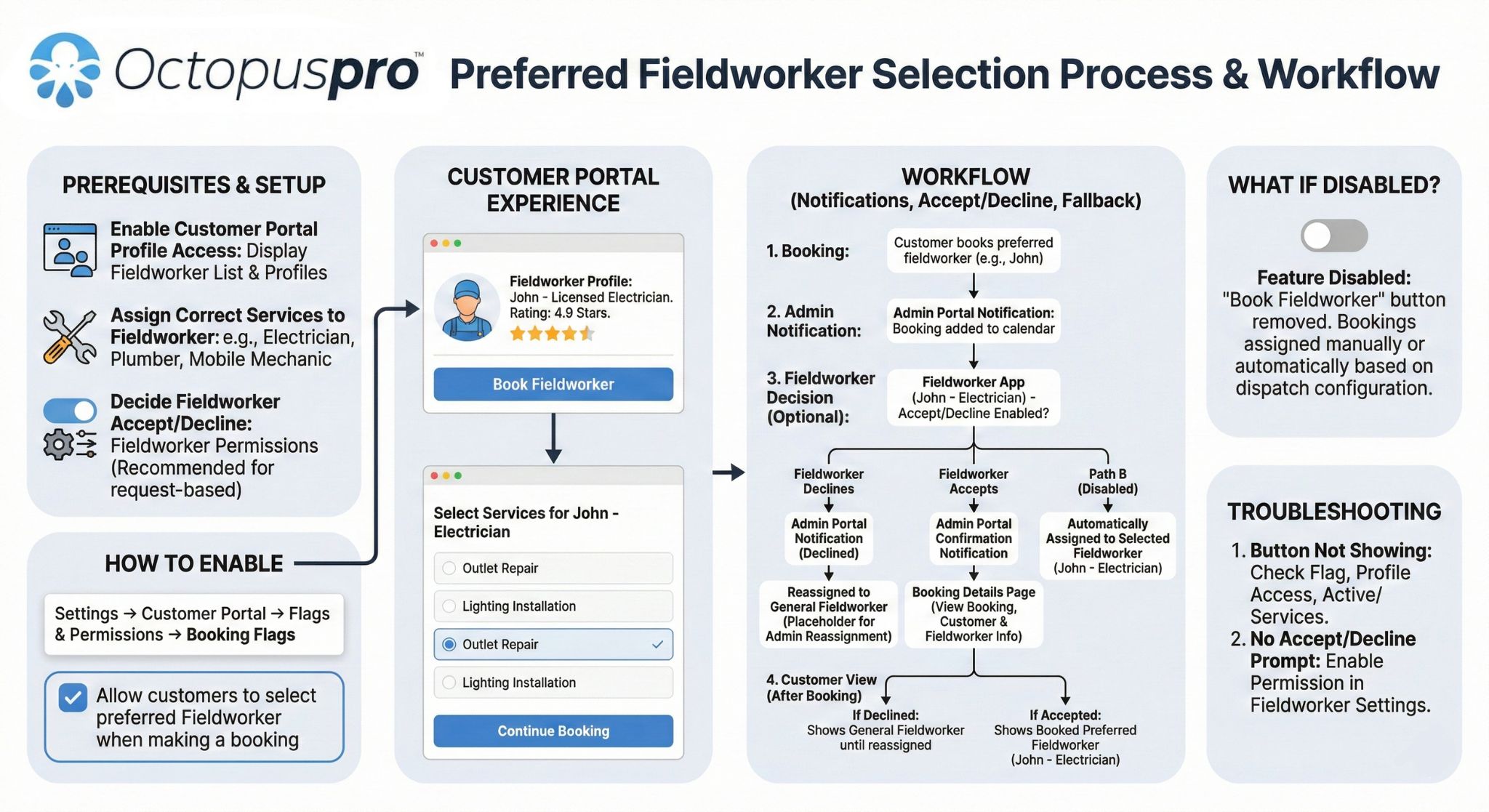
Learn more: Preferred Fieldworker Selection in the Portal
Allow customers to cancel bookings through customer portal and email links
Enable this to allow customers to cancel bookings from the portal (and optionally through links in booking emails).
Learn more: Customer Portal Booking Cancellation (Portal + Email Links)
Allow minimum time required before canceling settings
This sets a cancellation/reschedule cut-off (in hours) before the booking start time. If customers try to cancel/reschedule too late, OctopusPro blocks the action and shows your custom message.
- Allow customers to cancel and reschedule bookings up to (X) hours before the start of the booking: Set X in hours here.
- If it’s too late to cancel or reschedule: Enter the custom message customers will see (e.g., “It’s too late to change this appointment. Please contact us.”).
Learn more: Minimum Notice (Cut-off) for Cancellation/Reschedule + Custom Message
Allow customers to reschedule bookings through customer portal and email links
Enable this to allow customers to reschedule their booking via the portal and/or booking emails (if templates include the reschedule link).

Learn more: Customer Portal Reschedule Bookings (Portal + Email Links)
Allow guests to make bookings through customer portal

Enable this to allow visitors to place bookings without logging in first (guest checkout). This can increase conversions, especially for first-time customers.
Learn more: Allow Guests to Book Through the Customer Portal
Allow customers to select an exact start time for their bookings
Enable this if your business can commit to a specific start time. If disabled, customers may choose a time window (e.g., morning/afternoon) instead of an exact time.
Allow customers to upload photos when making a booking
Enable this to allow customers to upload photos during checkout (before submitting the booking). This helps scope work correctly and reduces back-and-forth.
Custom message to display in upload photos popup: Use this to tell customers what to upload (e.g., “Upload clear photos of the affected area and any damage.”).

Learn more: Allow customers to upload photos when making a booking
Make uploading images mandatory for customers when making a booking
Enable this to require at least one image upload before a booking can be submitted (useful for inspection-based work like repairs, restoration, installation, or painting).
Important: This requires the “Upload photos when making a booking” flag to be enabled too.
Allow customers to upload pdf through the booking page
Enable this to allow customers to upload PDFs to the booking after the booking is created (typically on the booking view page under attachments).

Learn more: Allow customers to upload PDF through the booking page
Allow customers to rate your bookings through the booking page
Enable this to show a Rate service button on the booking view page after the job is completed (and any required invoice conditions are met).
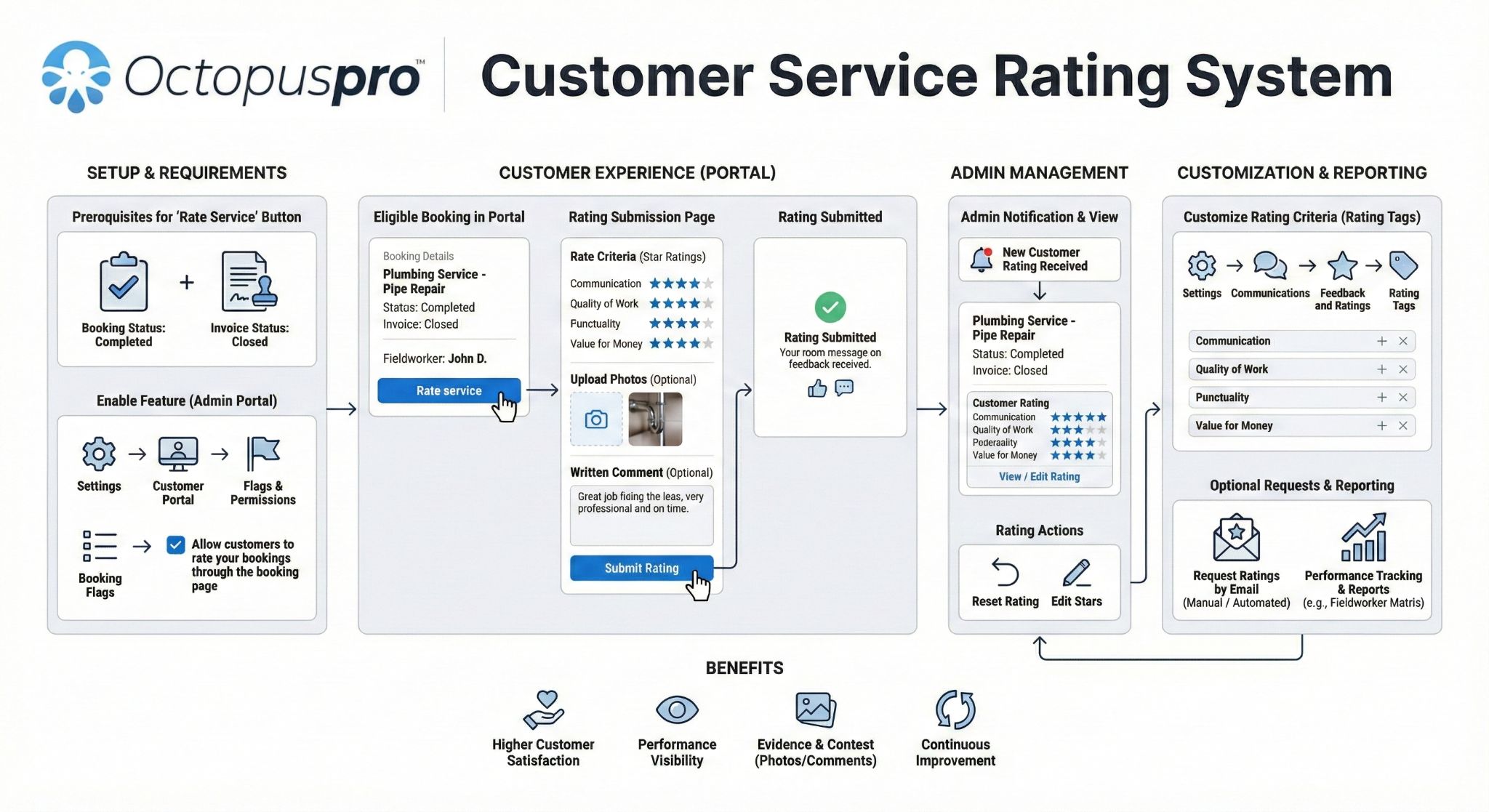
Learn more: Customer Portal Ratings (Rate Booking)
Display service and custom field pricing structure to customers
Enable this to show customers how pricing is calculated (base service price + custom field add-ons, where applicable).
Update service pricing on the go
Enable dynamic pricing updates during checkout so totals update instantly as customers add services/options (reduces surprises at checkout).
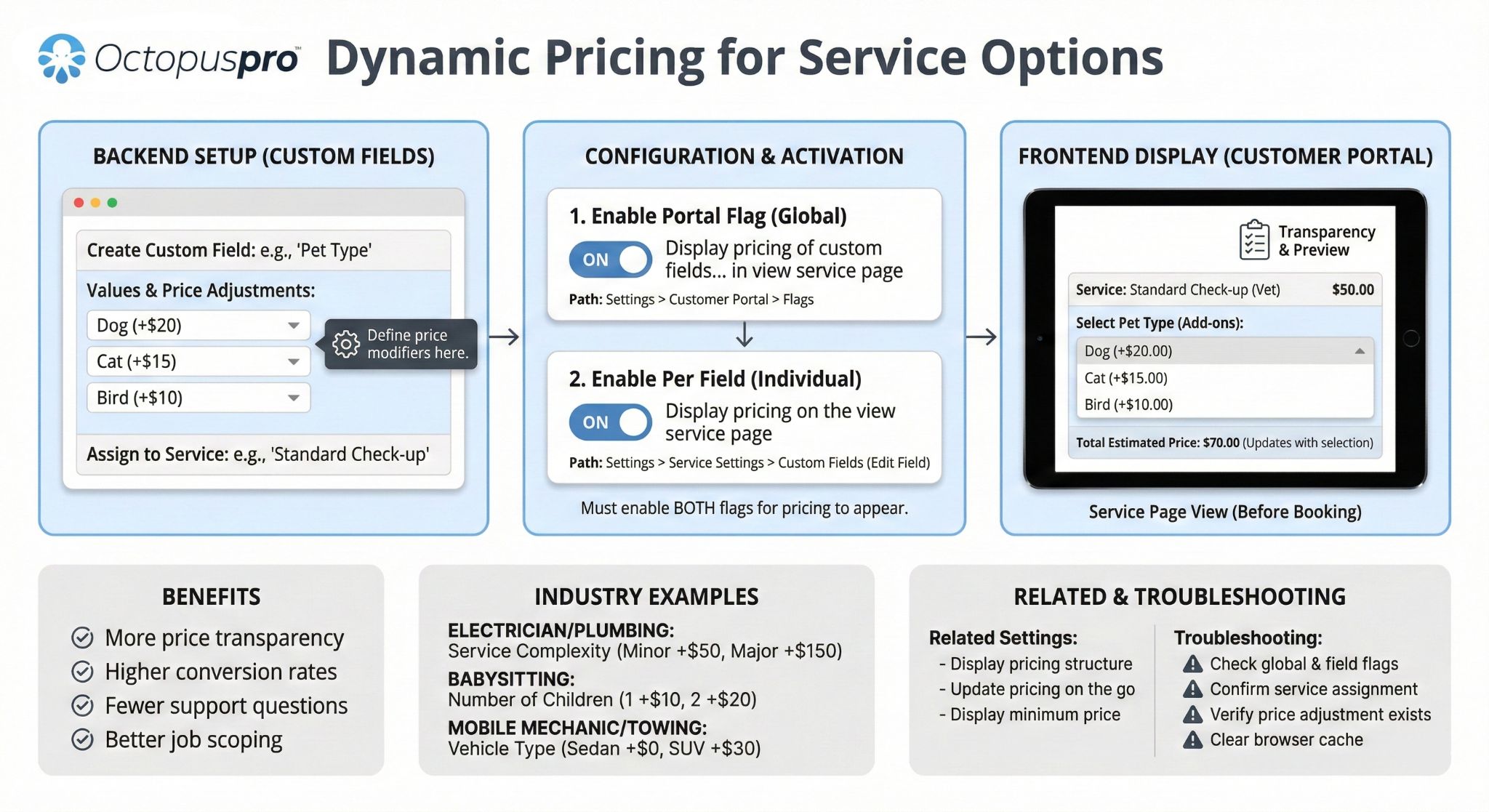
Learn more: Update Service Pricing on the Go
Display service minimum price
Enable this to show a minimum starting price for services where the final price may vary (e.g., “From $99”).
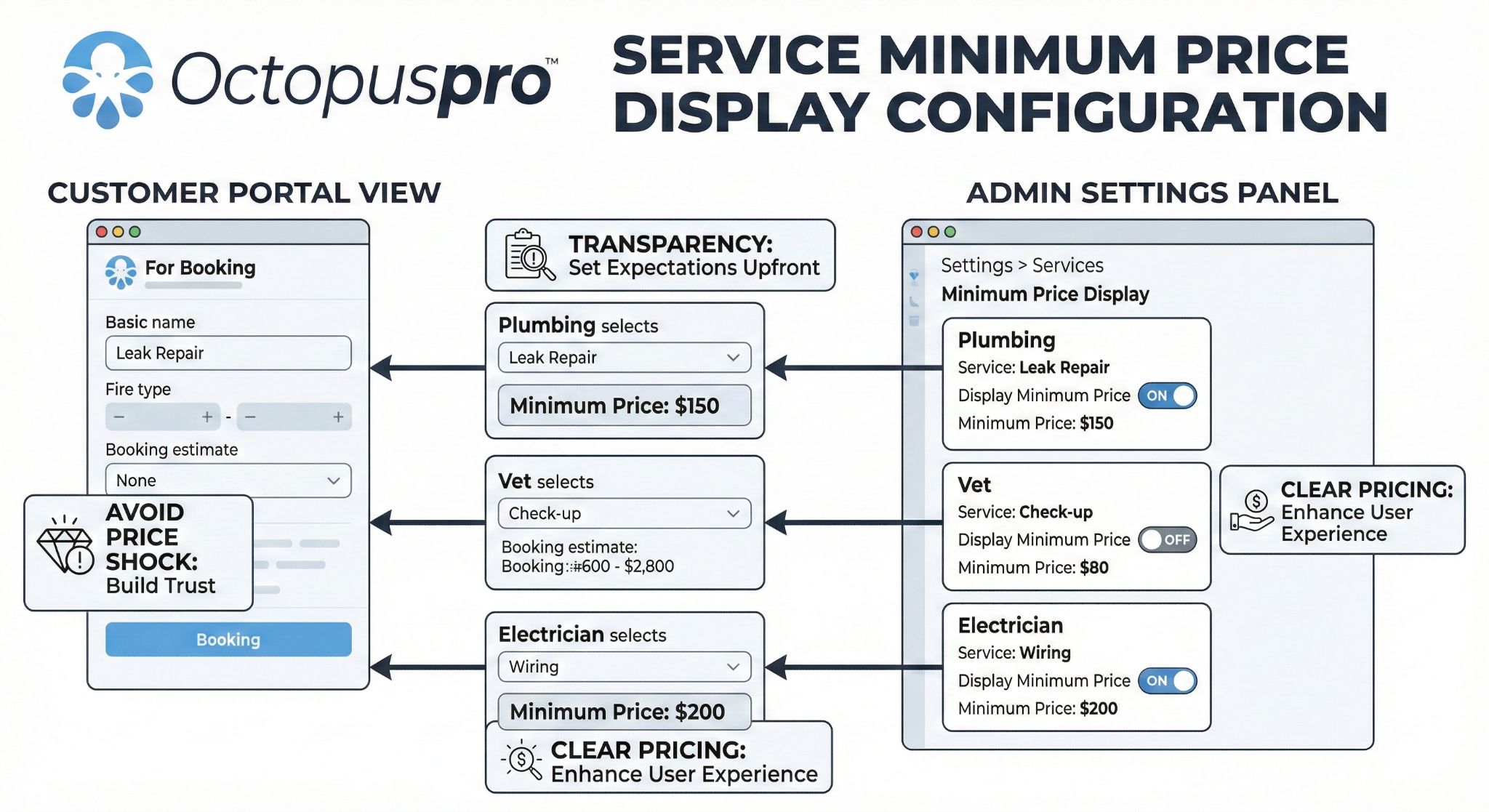
Learn more: Display Service Minimum Price in the Customer Portal
Display pricing of custom fields added to the service in the view service page
Enable this to show the prices for custom options (custom fields) on the service page, improving transparency and reducing price-related questions.
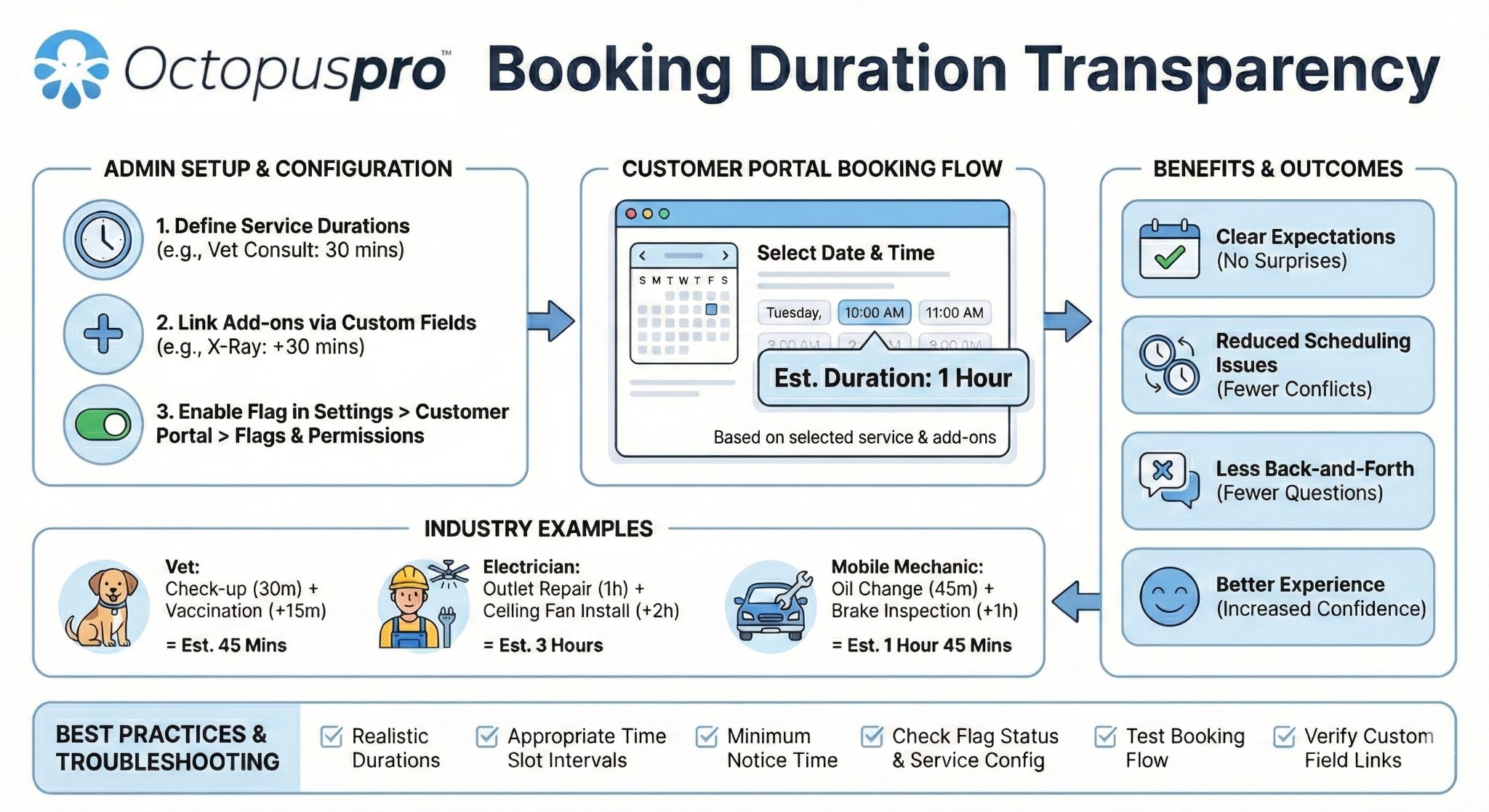
Display booking duration / estimated time to customers
Enable this to display the estimated duration of the service/booking. Helpful for managing expectations (“This service usually takes ~2 hours”).
Learn more: Display Booking Duration / Estimated Time
Display “Is parking available?” question during checkout
Enable this to ask customers about parking access during checkout—useful for mobile services and city locations to reduce delays.
Learn more: Display “Is Parking Available?” Question During Checkout
Display additional notes area for the customer during checkout
Enable this to add an Additional notes field so customers can provide instructions (gate codes, access details, pet notes, preferred contact method, etc.).

Learn more: Display Additional Notes (Checkout)
Select at least one customer property during booking process
Enable this to require customers to select at least one customer property (or location) during booking—ideal when customers manage multiple sites/addresses (property management, commercial clients, multi-site services).

Learn more: Require Customers to Select a Dependent, Asset, or Property During Online Booking
Fieldworker Flags
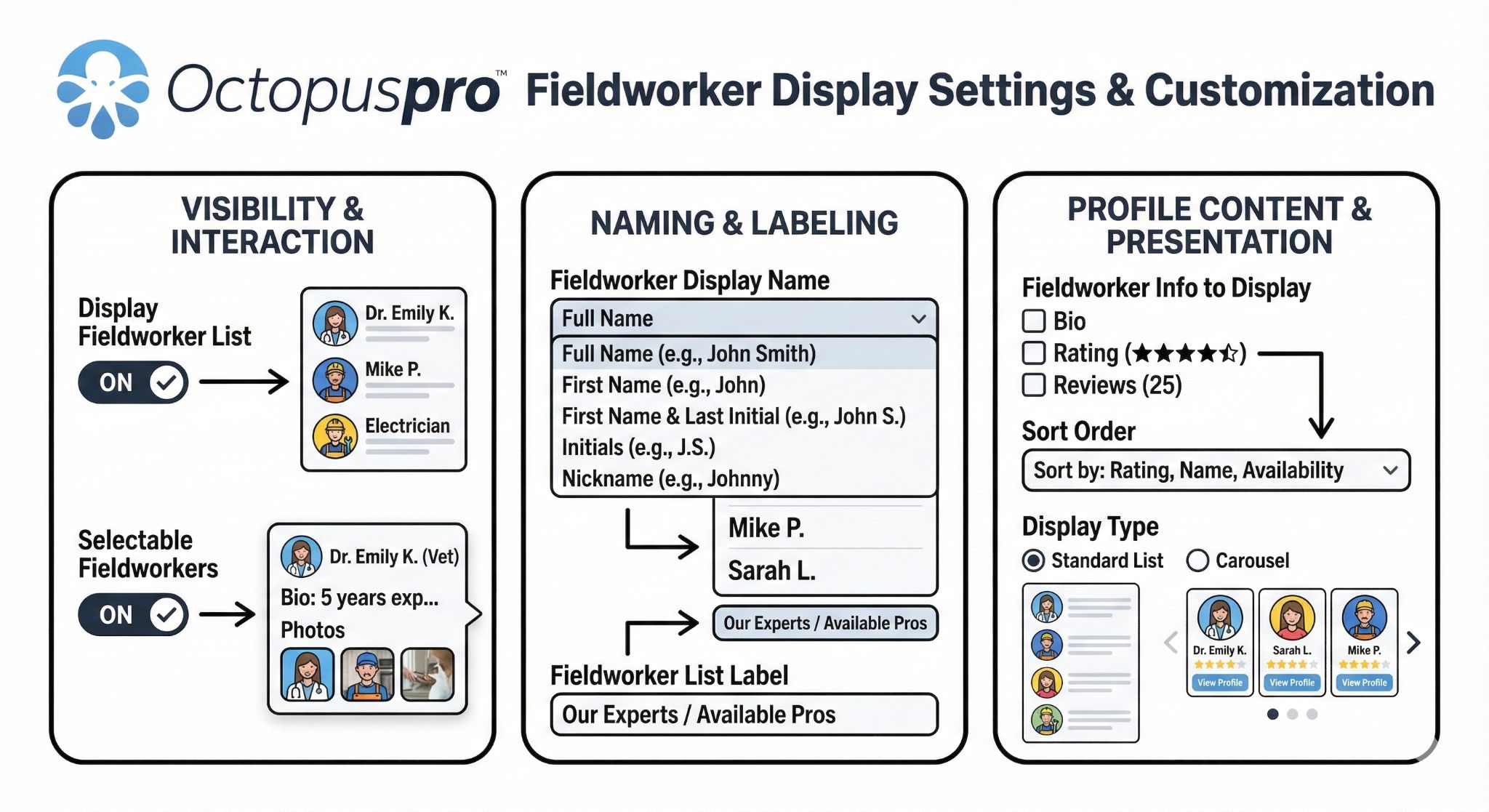
Display fieldworker name to customers
Enable this to show the fieldworker’s name (technician name) to customers in the portal and booking views (where applicable).
Display fieldworker contact details like email and phone number to customers
Enable this if customers are allowed to directly contact the assigned fieldworker (your business policy may vary).
Display fieldworker social networks links
Enable this to show social/profile links (e.g., portfolio, Instagram, LinkedIn) on public fieldworker profiles.
Learn more: Display Fieldworker Social Network Links
Display fieldworker star rating to customers
Enable this to show the fieldworker’s star rating (if you collect ratings) on their public profile—useful for trust and technician selection.
Learn more: Display Fieldworker Star Ratings
Display fieldworker list and make fieldworker profiles public
Enable this to publish the Fieldworkers page and allow customers to view public fieldworker profiles (and see which fieldworkers provide each service).
Learn more: Display Fieldworker List (Public Profiles)
Display fieldworker date joined to customers
Enable this to show “Member since” / join date on the fieldworker profile (adds trust and tenure transparency).

Learn more: Display Fieldworker Date Joined
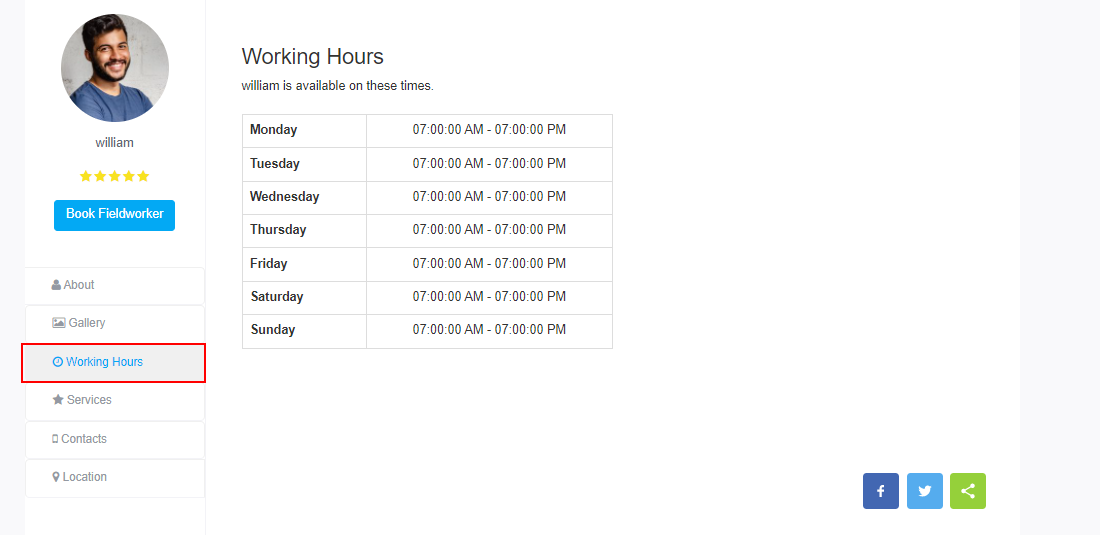
Display fieldworker working hours in fieldworker profile
Enable this to show a weekly schedule/working hours section on public fieldworker profiles (helps customers understand availability patterns).
Learn more: Show Technician Working Hours in Customer Portal
Enable real-time availability
When enabled, OctopusPro checks each fieldworker’s working hours and calendar availability before showing time slots. Customers will only see times where at least one matching fieldworker is actually available—reducing double-bookings and reschedule requests.

Learn more: Dynamic Real-time Fieldworker Availability Scheduling
Enable Service Area Validation
Enable this to validate booking locations against your configured service areas (geo-fencing / radius coverage). This helps prevent bookings outside coverage zones and reduces “we don’t service that area” cancellations.
- Typical behavior: customers are prompted/blocked if the address is outside the allowed service area (depending on your setup).
- Prerequisite: define service areas (per fieldworker and/or per service) and ensure the portal uses the correct booking location type configuration.
Related: Fieldworker Service Areas
Troubleshooting & best practices
Customers can’t see a change you just enabled
- Confirm you clicked Save after changing flags.
- Test in an incognito/private window to avoid cached sessions.
- Confirm you’re viewing the correct trading name/brand portal (if your account uses multiple trading names).
Customers can’t select times you expect to be available
- Check minimum notice time and the starting from option.
- Check time slot intervals (large intervals can “skip” expected times).
- If real-time availability is enabled, confirm at least one matching fieldworker has working hours set and is not already booked.
Cancellation/rescheduling is blocked unexpectedly
- Confirm whether minimum time required before canceling is enabled, and the hours value is correct.
- Review the custom blocked-action message to ensure it matches your policy and provides a clear next step (call/email).
Best-practice “starter configuration” (most field service teams)
- Minimum notice time: 60–180 minutes + time slot intervals 30–60 minutes
- Enable: Additional notes, Parking question, Upload photos (optional: mandatory photos)
- Enable: Cancel + Reschedule with a cut-off (e.g., 24 hours)
- Enable: Real-time availability if you want conflict-free self-scheduling
- Enable: Service area validation if you have strict coverage zones
To stay updated, please subscribe to our YouTube channel.