
eWAY Payment Gateway Integration
Connect eWAY to OctopusPro to accept secure online card payments wherever online payments are enabled in your account (for example: Customer Portal checkout and invoice payment links).
What this integration is for
The eWAY integration lets you:
- Get paid faster by allowing customers to pay online using credit/debit cards.
- Reduce admin work by capturing payments automatically against bookings/invoices (depending on your workflow).
- Improve the customer experience with a smooth checkout and payment process.
Before you start
- You need an eWAY merchant account (and access to your eWAY dashboard).
- You’ll need to collect the following eWAY credentials:
- API Key (Rapid API)
- API Password (Rapid API)
- Public API Key
- Client-Side Encryption (CSE) Key
Tip: If you haven’t configured your checkout/payment options yet, review your payment settings first: Managing Payment Methods and Service Payment Terms.
How to set up eWAY in OctopusPro
Step 1: Open the Payment Integration settings
In your OctopusPro account, go to: Settings > Financial Settings > Payment Integration.
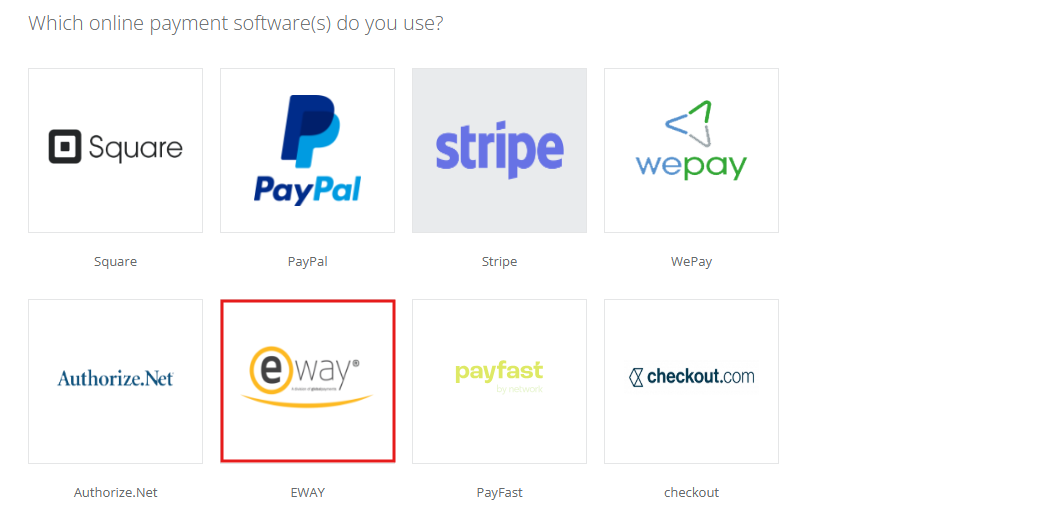
Step 2: Select eWAY
Find eWAY in the list of supported gateways and select it to open the configuration window.
Step 3: Enter your eWAY credentials
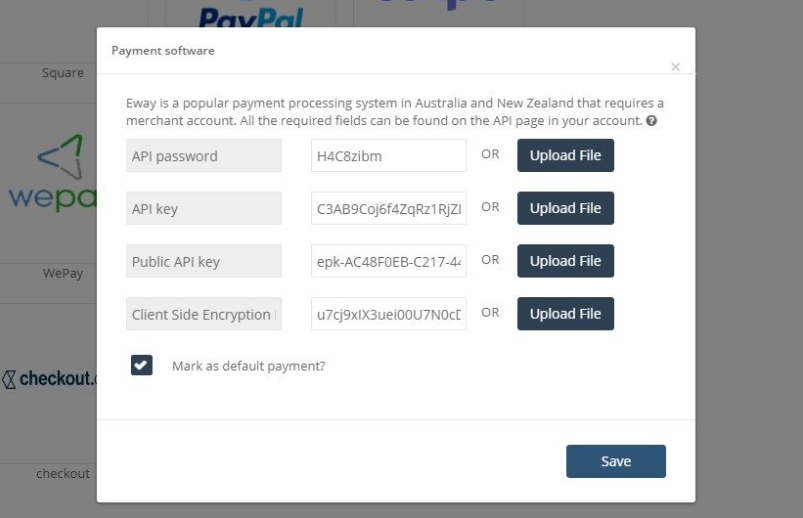
In the eWAY configuration window, enter the required values:
- API Password
- API Key
- Public API Key
- Client Side Encryption (CSE key)
You may also see an option such as Mark as default payment. Enable it if you want eWAY to be the default payment method.
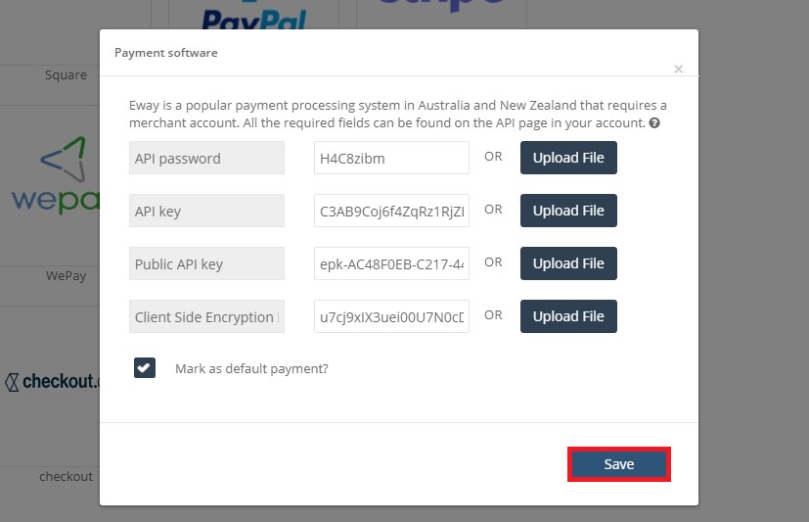
Step 4: Save the integration
Click Save to store your settings and activate the integration.
Where to find your eWAY API keys
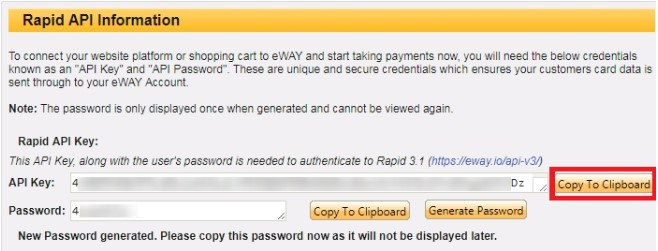
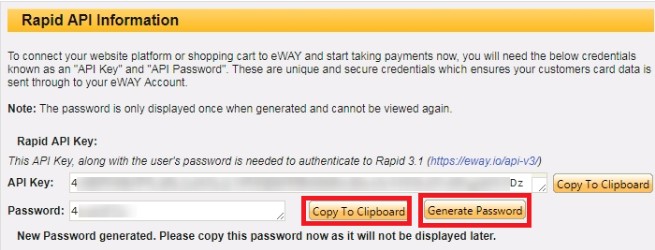
1) API Key + API Password (Rapid API)
Log in to your eWAY account and navigate to the section where your Rapid API credentials are shown. Your API Key and API Password are typically displayed together.
If you need a clearer view of each credential separately, refer to the examples below:
2) Public API Key
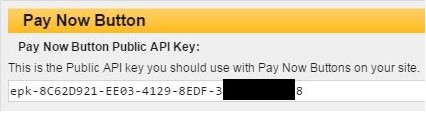
Your Public API Key is used for certain client-side payment operations and validation.
3) Client-Side Encryption (CSE) Key
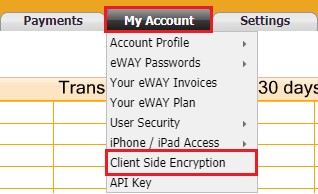
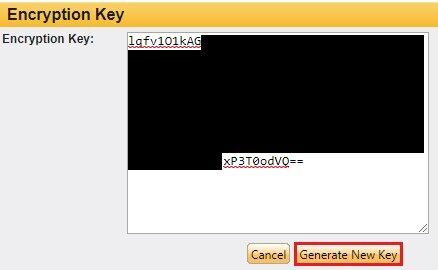
The Client-Side Encryption (CSE) Key helps protect sensitive card data during payment capture. Generate or copy your CSE key from your eWAY account where encryption settings/keys are managed.
How customers can pay
- Customer Portal / Online booking checkout: customers can pay when placing an online booking (if you’ve enabled online payments).
- Invoice payment links: customers can pay from an online invoice/payment page (if your workflow includes online invoice payments).
Helpful guides: Enable Online Bookings (Customer Portal setup), Paying Invoices / Booking Payments, Payments & Deposits for Bookings.
Best practices
- Keep credentials secure: only admins who manage payments should have access to gateway credentials.
- Use clear payment terms: define whether customers pay in full, pay a deposit, or pay later (per service).
- Test your end-to-end flow: run a real checkout/invoice payment using your preferred customer journey after setup.
- Monitor failed payments: if a payment fails, confirm credentials, customer card validity, and any eWAY account restrictions.
Troubleshooting
- Payments fail immediately: re-check that the API Key, API Password, Public API Key, and CSE Key are copied correctly (no extra spaces).
- Customer can’t see eWAY at checkout: confirm eWAY is enabled in your payment methods and that online payments are enabled for the booking/portal flow you’re using.
- Card details won’t validate: confirm your Public API Key and CSE Key are correct and active in your eWAY account.
- Declined payments: these can be caused by the customer’s bank, card limits, or fraud rules—ask the customer to try another card or contact their bank.
If you’ve confirmed settings and still need help, contact OctopusPro support with: (1) your company name, (2) the payment method you enabled (eWAY), (3) a screenshot of the error, and (4) the time of the attempted payment.
To stay updated, please subscribe to our YouTube channel.