
Multi-Location POS Software for Service Businesses (Branches, Storefronts & Mobile Teams)
If your business operates across multiple branches, storefronts, or service locations, you need a system that keeps sales (POS), bookings, staff scheduling, payments, and reporting connected—without managing separate systems per location.
OctopusPro supports multi-location service businesses by letting you run a centralized operations hub where customers can book the correct branch, your team can schedule and dispatch work accurately, and you can track performance across locations.

Quick navigation
- What this solves
- Who it’s for
- Key capabilities
- How multi-location works in OctopusPro
- Set up multi-location POS (step-by-step)
- Using POS day-to-day (walk-ins, counter sales & deposits)
- Scheduling & dispatch across locations
- Reporting & performance by location
- Best practices
- FAQs
- Related articles
What this solves
Multi-location service businesses commonly face these issues:
- Disconnected systems (separate POS, bookings, and staff scheduling per site).
- Double-bookings or incorrect assignment because staff availability isn’t tied to the right branch.
- Inconsistent pricing and invoicing across locations.
- Poor visibility on which branches are profitable, busiest, or under-utilized.
- Messy payments when you take deposits online but collect the balance in-store (or vice-versa).
OctopusPro brings these workflows together so you can operate multiple locations under one system while keeping scheduling, payments, and reporting structured.

Who it’s for
This setup is ideal for businesses that provide services through one or more of these models:
- Storefront / branch services (customers visit you): salons, clinics, studios, gyms, repair shops, car wash sites, laundromats, pet stores with services, etc.
- Mobile / on-site services: cleaning, trades, repairs, deliveries, maintenance, and any field service teams working across territories.
- Hybrid: businesses that offer both in-store and mobile services (e.g., retail + installation, clinic + home visits).

Key capabilities
- Branch/location-based bookings: customers and admins can select the correct location during booking creation.
- Centralized customer history: keep customer profiles, booking history, and invoices in one place.
- POS-style payments for services: take payments (full, partial, deposit, balance) and record them against invoices.
- Products & add-ons: sell products at the counter or add products to bookings/invoices when servicing a customer.
- Role-based access control (RBAC): limit staff access by role/permissions (and keep operational control consistent across sites).
- Scheduling & dispatch: coordinate staff calendars and assign the right team to the right location.
- Reporting & analytics: track performance and operational metrics across locations.
How multi-location works in OctopusPro
Multi-location support in OctopusPro is built around two core ideas:
- Service delivery types (storefront/branches, mobile/on-site, remote/virtual).
- Operational locations (your business sites, plus staff territories for mobile work).
Before you configure branches and POS workflows, make sure your account is set up with the correct service delivery model(s):
- Service Delivery Types: Storefront, Mobile & Remote
- Fieldworker Service Areas & Locations (Mobile, Storefront & Virtual)
Tip: Many businesses are hybrid. You can enable multiple service delivery types so bookings and POS flows match how each service is delivered.
Set up multi-location POS (step-by-step)
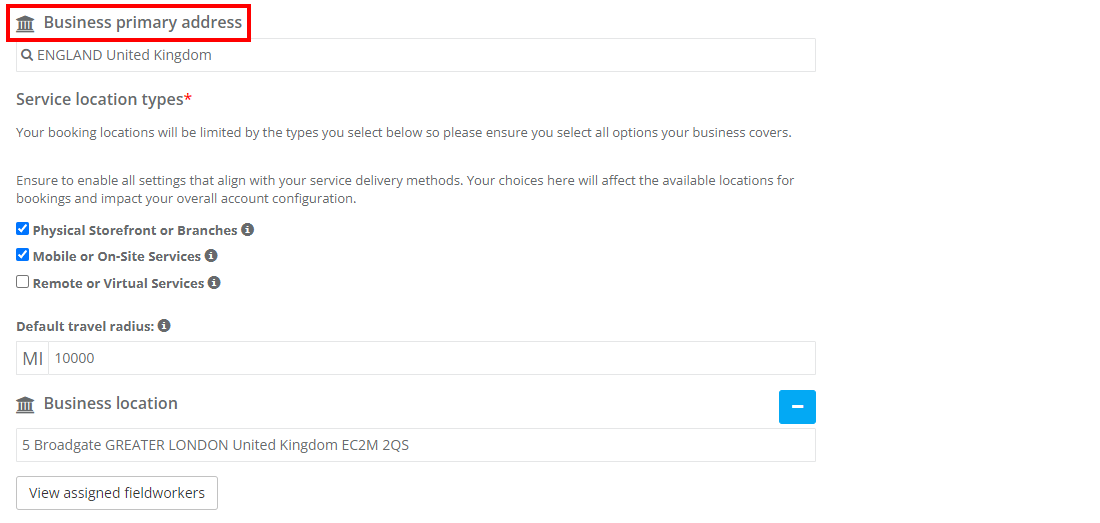
Step 1: Set your primary business location and enable service location types
Go to Settings > Company Settings > Locations and confirm:
- Your Primary business address is correct.
- Your Service location types match your delivery model (storefront/branches, mobile/on-site, remote/virtual).
Step 2: Configure branches / storefront locations
If you run physical sites, add each branch/storefront so bookings can be tied to the correct location. This ensures:
- Customers can book the correct branch.
- Admins can create bookings for a specific location.
- Your calendar can be filtered by location for easier scheduling.
Related: Configure booking location types and branch workflows
Step 3: Assign services (and optional products) for consistent POS billing
To run POS-style billing consistently across locations, make sure your catalogue is structured:
- Services: standardized naming, duration, and pricing (where applicable).
- Products/add-ons: items you sell at the counter or add during service delivery.
Related: Products List Management & Inventory Tracking
Step 4: Configure payment methods for POS and invoices
Go to your payment settings and enable the payment methods you want to accept (e.g., card, cash, bank transfer, gateway payments). This allows you to collect payments and record them properly against invoices.
- Payment Methods Configuration
- Add Invoice Payments (POS-style payment entry)
- View Payments, Receipts & Refunds
Step 5: Confirm taxes and invoice presentation
If you operate multiple sites, make sure your tax setup is correct and invoices are formatted consistently.
Step 6: Add staff, working hours, and access permissions
Multi-location operations work best when staff accounts are properly set up:
- User accounts: create users for admins/office staff.
- Fieldworkers: create fieldworker profiles for on-site teams (or branch-based staff schedules).
- Working hours: ensure calendars reflect availability.
- Permissions: restrict access using role-based permissions.
- User & Role Management
- Role-Based Access Control (RBAC) & Permissions
- Fieldworker & Subworker Management
- Manage Fieldworker Working Hours & Availability
- Manage Subworkers Under Fieldworkers (Crew Members)
Using POS day-to-day (walk-ins, counter sales & deposits)
OctopusPro’s POS-style workflow for service businesses typically follows this structure:
Scenario A: Walk-in customer (service only)
- Create a booking for the customer (select the correct branch/location).
- Add the service(s) and confirm scheduling.
- Create the invoice (if not generated automatically).
- Take payment (full payment, partial payment, or deposit).
- Provide the receipt/invoice to the customer.
Guide: Create a New Booking
Scenario B: Walk-in customer (service + products)
- Create/locate the customer profile.
- Create the booking (if it’s an appointment) or invoice directly (if it’s a counter sale).
- Add service(s) and add product(s) as line items.
- Take payment and issue the receipt/invoice.
Guide: Products List Management & Inventory Tracking
Scenario C: Deposit now, balance later (common for multi-location)
For bookings where a customer pays a deposit online or in-store and pays the remaining balance at the appointment:
- Record the deposit payment against the invoice.
- Collect and record the remaining balance later (in-store, onsite, or via online invoice link).
Guides:
Scheduling & dispatch across locations
A major benefit of multi-location setup is being able to schedule by branch and dispatch work efficiently.
- Filter your calendar by location to manage each branch schedule independently.
- Use job assignment rules to control how bookings get assigned (manual vs automated).
- Assign multiple staff to one booking when work requires a team (e.g., crews, assistants, multi-trade jobs).
- Filter Calendar by Area / Location
- Job Assignment & Dispatch (Manual vs Automatic)
- Assign Multiple Fieldworkers to a Booking
Reporting & performance by location
With multiple locations, you need reporting that helps you compare performance across branches and identify what to improve.
Use reporting to track:
- Bookings volume and revenue trends
- Top services and products
- Outstanding invoices and payments
- Staff utilization and workload distribution
- Location performance comparisons (where applicable)
Guide: Live Reports & Analytics
Best practices
- Standardize services: keep naming, durations, and pricing consistent across locations unless you intentionally vary by branch.
- Use permissions properly: apply role-based permissions so staff only see what they need to do their job.
- Keep working hours accurate: availability data drives scheduling quality and prevents booking conflicts.
- Separate “booking creation” from “payment collection”: it’s common to schedule first and collect payment later—use invoice payment recording to keep it clean.
- Use calendar filtering daily: branch calendars are easier to manage when filtered by location or team.
FAQs
Can I run both branches and mobile teams?
Yes. Many businesses run storefront locations for some services and mobile/on-site delivery for others. Enable the relevant service location types and configure both branch locations and fieldworker service areas.
Can customers choose the branch when booking online?
Yes—when storefront/branch services are enabled, customers can be guided to book at the correct location (depending on your configuration and service availability).
Can I take a deposit online and the balance in-store?
Yes. Record each payment against the same invoice so balances remain accurate and auditable.
Can I offer remote/virtual services alongside in-person services?
Yes. If you provide online services (consulting, coaching, telehealth, etc.), you can enable remote services and configure how they’re delivered to customers.
Remote Service Management & Virtual Bookings
Related articles
- Service Delivery Types: Storefront, Mobile & Remote
- Fieldworker Service Areas & Locations
- Payment Methods Configuration
- Add Invoice Payments
- Manage Tax Rates
- Customize Invoice Template
- Filter Calendar by Area / Location
- Live Reports & Analytics
- Role-Based Access Control (RBAC) & Permissions
To stay updated, please subscribe to our YouTube channel.