
Service Booking Management (Bookings & Appointment Scheduling)

OctopusPro’s Service Booking Management module helps you manage the full lifecycle of a job—from capturing booking requests and scheduling appointments to dispatching fieldworkers, tracking status updates, and collecting payments. Whether you run a local service business, a multi-location team, or a subcontractor network, OctopusPro gives you a single system to schedule, dispatch, communicate, and reconcile every booking.
This guide provides a high-level summary of all booking-related features available in OctopusPro, with links to detailed step-by-step articles for each workflow.
Table of contents
- Booking basics: Booking vs Service vs Appointment
- Capture bookings from any channel
- Scheduling & dispatch (availability, routing, and assignments)
- Manage booking records (view, edit, delete, audit)
- Customer & fieldworker communications
- Calendar sync (Google Calendar)
- Invoices, payments, refunds & reconciliation
- Quality control: approvals & governance
- Reporting, export & operational visibility
- Booking features index (quick links)
Booking basics: Booking vs Service vs Appointment
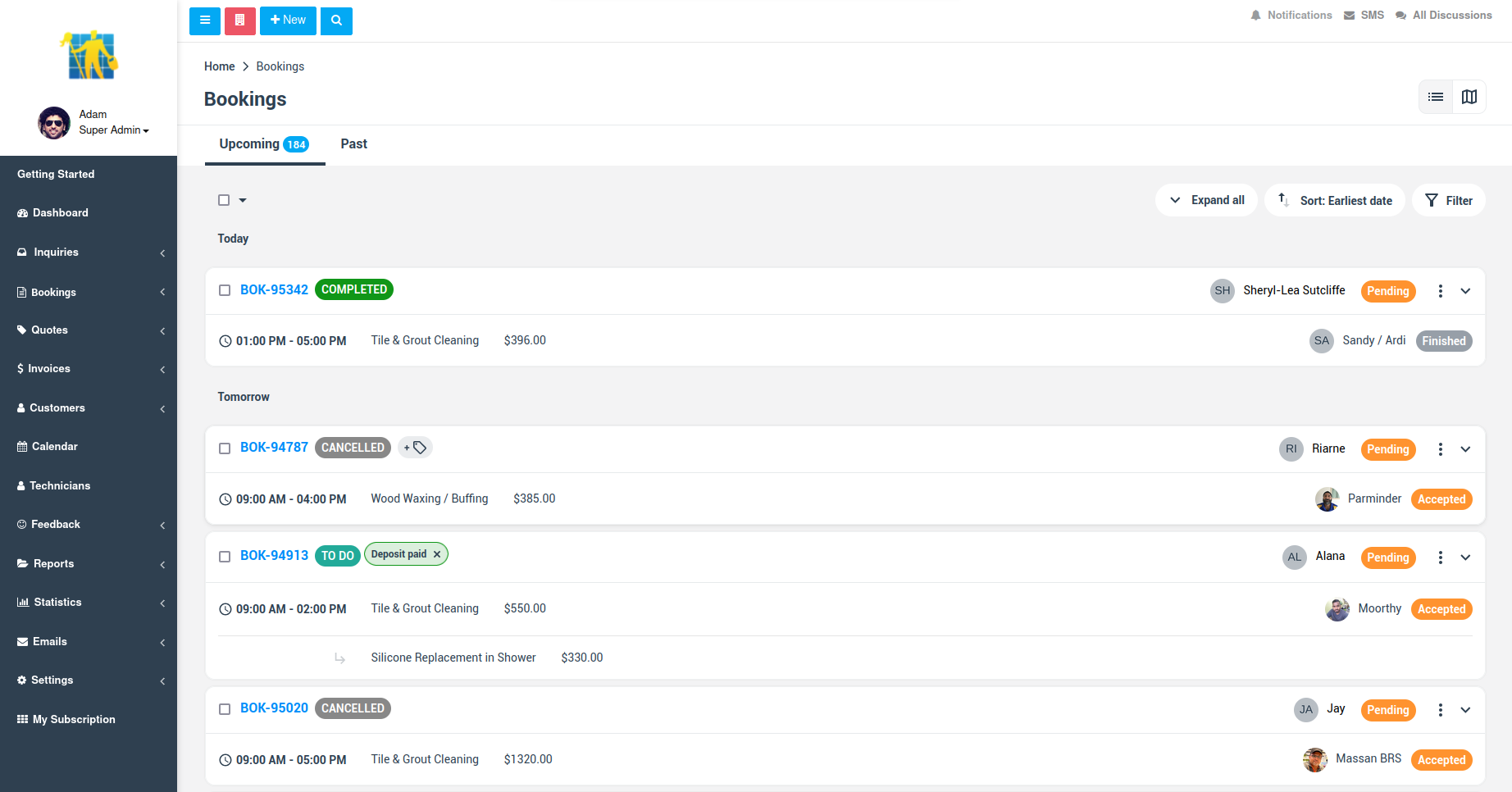
To manage bookings effectively, it helps to understand how OctopusPro structures job records:
- Booking = the overall job/work order for the customer (the main record).
- Service = a line item inside the booking (e.g., “Tile Cleaning”, “HVAC Repair”). A booking can contain one or multiple services.
- Appointment = a scheduled visit (date/time) for a service. A service can have one or multiple appointments (useful for follow-ups, multi-visit jobs, or crew scheduling).
This structure lets you run simple one-visit jobs, multi-visit jobs, and team/crew jobs without creating duplicate bookings.
Capture bookings from any channel
OctopusPro supports multiple booking capture paths so customers and staff can create bookings in the way that suits your business:
- Online bookings via customer portal / booking widget (instant bookings or booking requests, with optional online payment/deposit).
- Staff-assisted bookings created by admins via web or mobile when customers call, email, or message.
- Standardised data capture using custom fields, forms/checklists, job notes, and attachments to ensure you collect the right details every time.
- Multi-address bookings for jobs that cover multiple sites/locations under one booking flow.
Start here: Create a new booking
Scheduling & dispatch (availability, routing, and assignments)
1) Real-time availability matching
Use availability tools to reduce double-bookings, increase utilisation, and confirm appointments faster:
- Fieldworker Availability Finder to locate qualified fieldworkers based on working hours, existing bookings, and eligibility rules.
- Skill/eligibility matching so only suitable fieldworkers appear for specific services (based on your configuration).

Learn more: Fieldworker Availability Finder
2) Proximity-based scheduling (route optimisation)
For mobile teams, OctopusPro helps you reduce travel time and schedule smarter:
- Nearby Bookings visualises jobs on a map and helps dispatchers assign the closest qualified fieldworker.
- Use map, list, and timeline views to balance distance, availability, and workload.

Learn more: Nearby Bookings (Proximity Scheduling)
3) Assign one or multiple fieldworkers
Support both single-tech and team-based delivery:
- Assign multiple fieldworkers by creating multiple appointments under the same service (crew jobs or multi-visit specialist assignments).
- Track each appointment separately while keeping everything under one booking record.
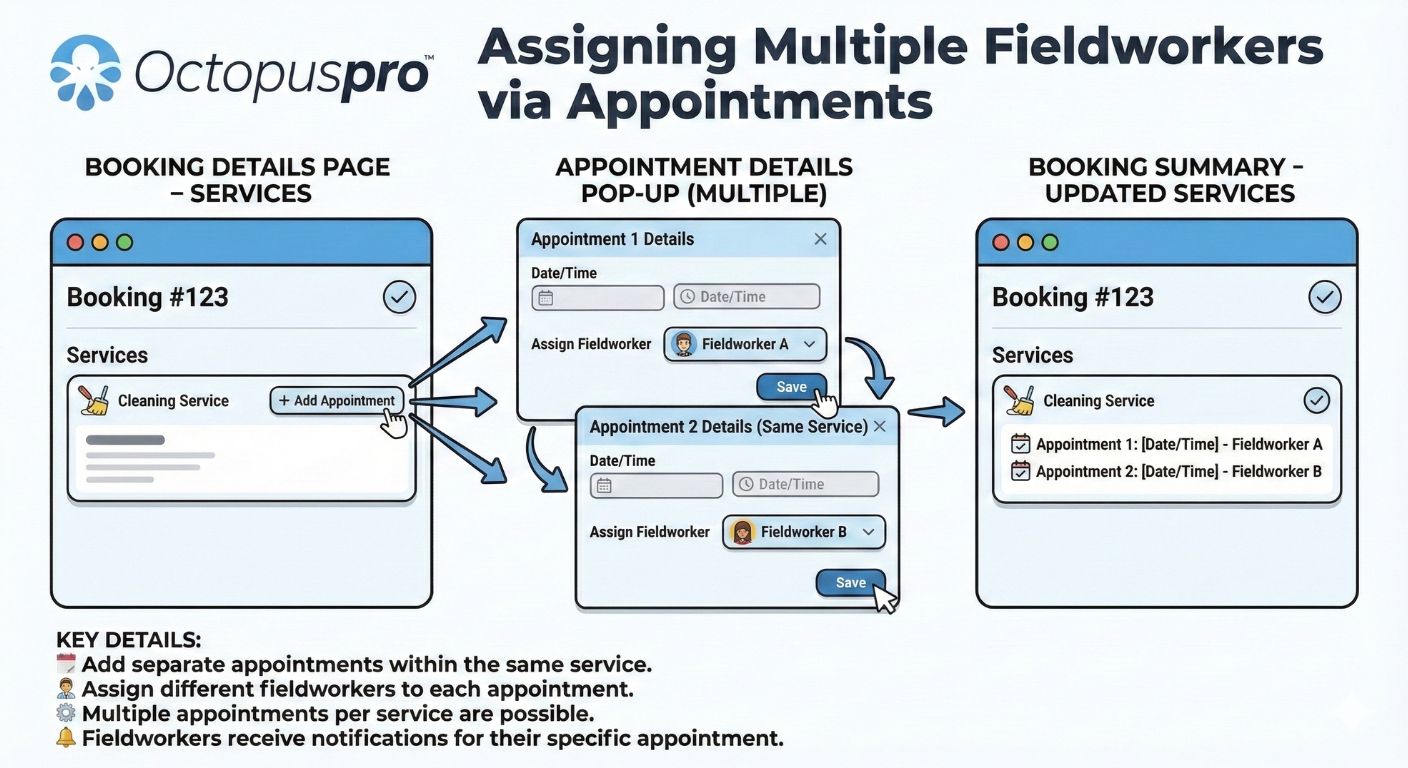
Learn more: Assign multiple fieldworkers to a booking
4) Rescheduling automation
Reduce admin overhead and keep customers informed when schedules change:
- Enable fieldworker rescheduling workflows (subject to your permissions and automation settings).
- Maintain auditability and customer communication consistency during changes.

Learn more: Fieldworker Rescheduling Automation
5) Recurring bookings (repeat appointments)
For businesses that deliver repeat services (weekly, fortnightly, monthly), recurring bookings help customers and staff schedule multiple appointments faster and consistently:
- Allow customers to create repeat bookings via the portal (based on your portal settings).
- Support multi-visit schedules without manual re-entry.

Learn more: Recurring bookings
Manage booking records (view, edit, delete, audit)
View booking details
Every booking has a central record where admins can access scheduling, customer/job details, notes, attachments, issues, and financial information—without jumping between modules.

Learn more: View booking details
Edit booking details
Update booking information as requirements change—such as time, services, pricing, addresses, assigned fieldworkers, and appointment structure.

Learn more: Edit booking details
Delete bookings (with safeguards)
OctopusPro supports booking deletion workflows designed to protect data integrity—especially when invoices, payments, or audit records exist.

Learn more: Delete a booking
Booking history & audit trail
Maintain operational accountability with a booking history log (who changed what, when, and from where). This is especially useful for compliance, dispute resolution, and internal governance.

Learn more: Booking history (audit log)
Ownership & responsibility
In teams, it’s important to know who owns a booking record for follow-up, communication, and internal accountability. OctopusPro supports workflows to claim/assign responsibility for a booking.

Learn more: Claim ownership of a booking
Customer & fieldworker communications
OctopusPro includes booking communication tools to reduce no-shows, improve transparency, and keep all parties aligned:
- Send booking confirmations to customers (email/SMS, depending on your configuration).
- Send booking emails for updates, requests, instructions, and attachments.
- Automated service reminders to reduce missed appointments.
- Request booking updates when you need customer confirmation or additional information.
- Pause/resume automated job communications for exceptional cases (e.g., disputes, sensitive cases, or manual handling).
- Contact tools to message customers or fieldworkers directly from the booking context.
- Field Service Discussion Board for internal collaboration tied to the booking/job record.
- Guide: Send booking confirmation
- Guide: Send emails for bookings
- Guide: Service reminder automation
- Guide: Request booking update
- Guide: Pause/resume job auto communications
- Guide: Contact customer from a booking
- Guide: Contact fieldworker from a booking
- Guide: Field service discussion board
Calendar sync (Google & Outlook Calendars)
OctopusPro’s Google Calendar Sync keeps your scheduling consistent across OctopusPro and Google Calendar, so your team can manage bookings, appointments, and availability without double-entry. Once connected, OctopusPro appointments are pushed to Google Calendar in real time, and your Google Calendar events are imported into OctopusPro to automatically block availability and prevent scheduling conflicts.
How Google Calendar sync works
- OctopusPro → Google Calendar (appointments): When a booking appointment is created or updated in OctopusPro, a corresponding Google Calendar event is created/updated. Tip: For best results, reschedule OctopusPro-created appointments in OctopusPro (changes made directly in Google Calendar may not update the original OctopusPro appointment).
- Google Calendar → OctopusPro (availability blocking): Events created in Google Calendar sync into OctopusPro as calendar events that block availability. These events do not create bookings in OctopusPro—they simply prevent double-booking.
- Future events sync: To reduce data transfer and keep calendars fast, the integration focuses on syncing future events.
What you’ll see in Google Calendar for OctopusPro bookings
When an appointment is synced to Google Calendar, the event can include key booking details such as booking status, assigned fieldworker, customer and address details (including multi-address support where applicable), service information, and scheduled start/end times (shown in the customer’s time zone).
Unavailable time blocks
You can create Unavailable events in OctopusPro to block time (breaks, personal commitments, travel buffers). These time blocks can sync to Google Calendar so your availability stays accurate everywhere.
Fieldworker-level permissions & connection
Calendar sync is authorized per fieldworker using Google permissions (OAuth). After a fieldworker connects, OctopusPro can create a dedicated calendar in their Google account (typically labeled with your company name), allowing them to view work bookings alongside their personal calendars in one place.
Control which bookings sync (status-based rules)
You can control exactly which bookings push to (or delete from) Google Calendar using booking status rules—ideal for preventing tentative jobs from appearing on calendars until they’re confirmed.
- Push to Google Calendar: Choose which booking statuses should sync to assigned fieldworkers’ Google Calendars.
- Delete from Google Calendar: Automatically remove Google events when a booking is deleted or reassigned (subject to authorization and status rules).

Learn more:
Sync Google Calendar With OctopusPro
Google Calendar Integration with OctopusPro
Invoices, payments, refunds & reconciliation
OctopusPro connects booking operations to billing so you can track revenue in real time and reduce reconciliation effort:
- Invoice generation can be automatic (based on status/milestones) or manual (on-demand).
- Online and offline payments can be collected or recorded (card, bank transfer, cash, etc., based on your setup).
- Payment visibility directly inside the booking via invoice/payment summaries (e.g., totals, paid, balance, overdue).
- Refund workflows to record or process refunds with proper controls and traceability.
- Payment reconciliation tools to review unapproved/approved transactions and match payments to invoices.

- Guide: Invoice payments (online & offline)
- Guide: Booking payment tracking & reconciliation
- Guide: Add a refund to a booking
- Guide: View refunds for a booking

Tip: If you operate with subcontractors or multi-tech appointments, you can connect booking revenue to payroll/commission rules for accurate payouts.

Quality control: approvals & governance
OctopusPro includes governance controls commonly required by field service businesses—especially those using subcontractors, multi-admin teams, or strict pricing/service rules:
- Admin override for booking requests: authorised staff can accept/decline/pend requests on behalf of fieldworkers when dispatch decisions must be made quickly.
- Approval for fieldworker changes: require office approval before changes to services, quantities, or prices take effect (prevents billing surprises and protects margin).

Reporting, export & operational visibility
To support operations, compliance, and reporting, OctopusPro includes tools to review and export booking data:
- Export booking for sharing job details with customers, internal teams, or external stakeholders.
- Attachments and photos stored against booking/quote/inquiry records for evidence, QA, and documentation.

- Labels (tags) for categorisation, segmentation, and filtering (e.g., “VIP”, “Urgent”, “Warranty”, “Repeat Customer”).

- Issues handling workflows to log and manage job issues tied to bookings/quotes/invoices.

- Guide: Export booking
- Guide: Attachments & photos (bookings/quotes/inquiries)
- Guide: Booking & quote labels
- Guide: Handle an issue (booking/quote/invoice)
Booking features index (quick links)
| Category | What you can do | Related guides |
|---|---|---|
| Create & capture | Create bookings, capture customer details, add services, schedule appointments | Create new booking Multi-address bookings |
| View & manage | View booking record, timeline, services/appointments, customer/job details | View booking details Edit booking details Delete booking |
| Scheduling & dispatch | Find availability, assign fieldworkers, optimise routing, reschedule safely | Availability Finder Nearby Bookings Assign multiple fieldworkers Rescheduling automation |
| Recurring services | Schedule repeating appointments for ongoing service delivery | Recurring bookings |
| Communications | Confirmations, reminders, update requests, internal collaboration | Booking confirmation Booking emails Reminder automation Request booking update Discussion board |
| Approvals & governance | Office oversight, admin overrides, controlled fieldworker changes | Admin accept/decline Approve fieldworker changes |
| Google & Outlook Calendar sync | Sync bookings to a fieldworker’s Google & Outlook Calendar | Sync to Google Calendar |
| Billing & payments | Invoice creation, payment tracking, reconciliation, refunds | Invoice payments Payment tracking Add refund View refunds |
| Audit, export & documentation | Audit trails, exports, attachments, labels, issue handling | Booking history (audit) Export booking Attachments & photos Labels Handle issues |
| Payroll & commissions | Connect bookings to fieldworker earnings rules and payouts | Payroll management Commission & pay rates |

Status tabs at a glance
| Tab | Purpose | Typical action |
|---|---|---|
| Upcoming | Jobs scheduled for future dates | Confirm resources & send reminders |
| Past | Completed jobs | Trigger review requests or upsells |
| Pending Approval | Awaiting internal sign-off | Manager reviews scope & cost |
| Pending Confirmation | Awaiting customer OK | Auto-email reminder, expiry timer |
| Pending Acceptance | Awaiting fieldworker reply | Escalate or reassign after X hours |
| Awaiting Update | Tech must add notes/photos | Push mobile notification |
| Not Assigned | No tech allocated yet | Run Find & assign |
| Declined | Rejected by tech | Activate service-recovery workflow |
Tangible benefits
- 30 % faster dispatch thanks to a real-time, colour-coded schedule board.
- Higher utilisation by surfacing unassigned slots and late-running jobs.
- Reduction in no-shows through automated confirmations and deposit workflows.
- Improved CX via proactive recovery emails when a booking is declined or delayed.

Next step
If you want the complete booking workflow (from creation → dispatch → completion → billing), start with: Create a New Booking and then move to View Booking Details.
Note: Feature availability can vary depending on your plan and system configuration (permissions, customer portal flags, automation settings, payment gateways, and integrations).
To stay updated, please subscribe to our YouTube channel.