
Reopening a Closed Issue or Complaint
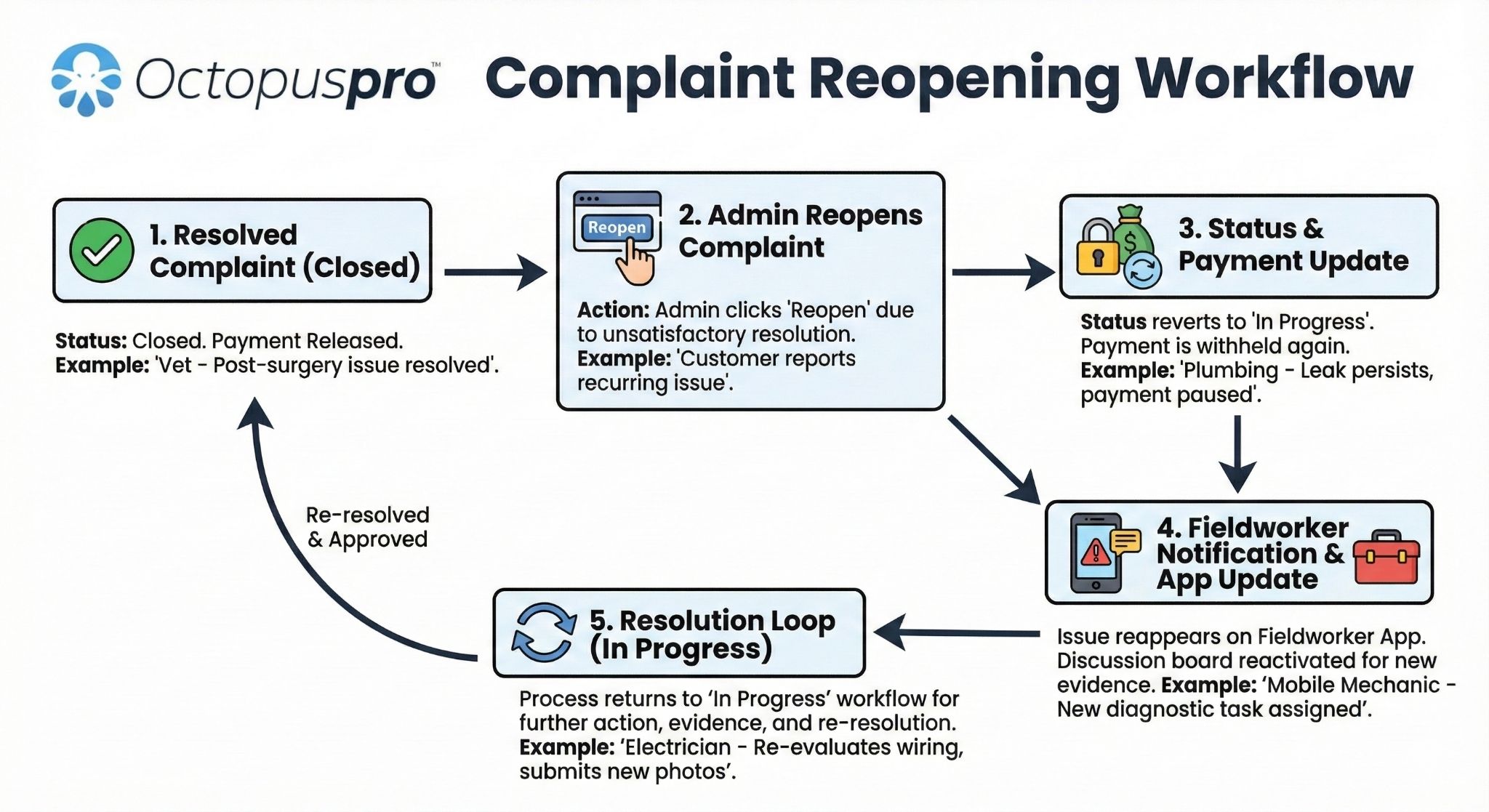
Sometimes an issue gets marked as resolved and closed, but the customer reports that the problem is still happening—or new information comes to light after closure. OctopusPro lets you reopen closed issues and complaints (also known as reopening a ticket or case) so your team can continue the resolution process with full context, ownership, and history preserved.
On this page
- When should you reopen an issue?
- Before you start
- How to reopen a closed issue (step-by-step)
- What happens after you reopen an issue?
- Reasons & examples
- Benefits of reopening (for service quality & trust)
- Best practices after reopening
- Related guides
When should you reopen an issue?
Reopening is appropriate when a closed issue needs further action, such as:
- Unresolved outcome: the original fix didn’t fully solve the problem or the issue returned shortly after closure.
- Customer rejects the resolution: the customer isn’t satisfied with the result or expects additional corrective work.
- New evidence appears: new photos, notes, or details change what needs to be done.
- QA/management review: an internal review identifies missed steps, missing documentation, or an incorrect closure.
Before you start
- Permissions: The ability to reopen issues depends on your user role and access permissions.
- Locate the issue: You can find it via the Issues list and switch to the Closed tab/list.
- Tip: Add a short note explaining why you’re reopening the issue so the reason is clear in the audit trail.
How to reopen a closed issue (step-by-step)
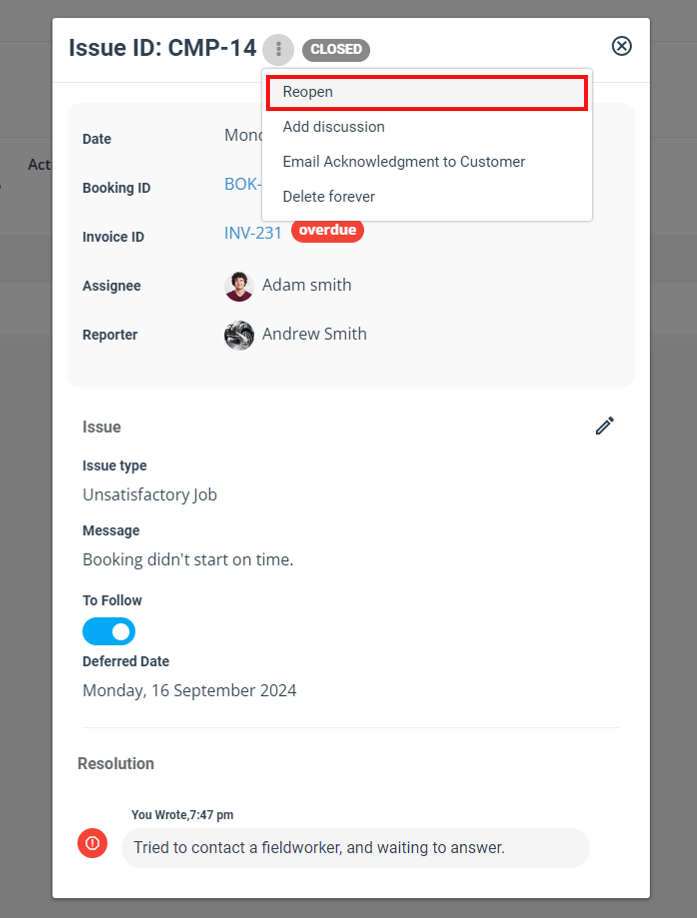
- Open the issue details:
- Navigate to the relevant issue/complaint you want to reopen.
- Click the Issue ID to view the full issue details.
- Reopen the issue:
- Click Actions.
- Select Reopen from the dropdown menu.
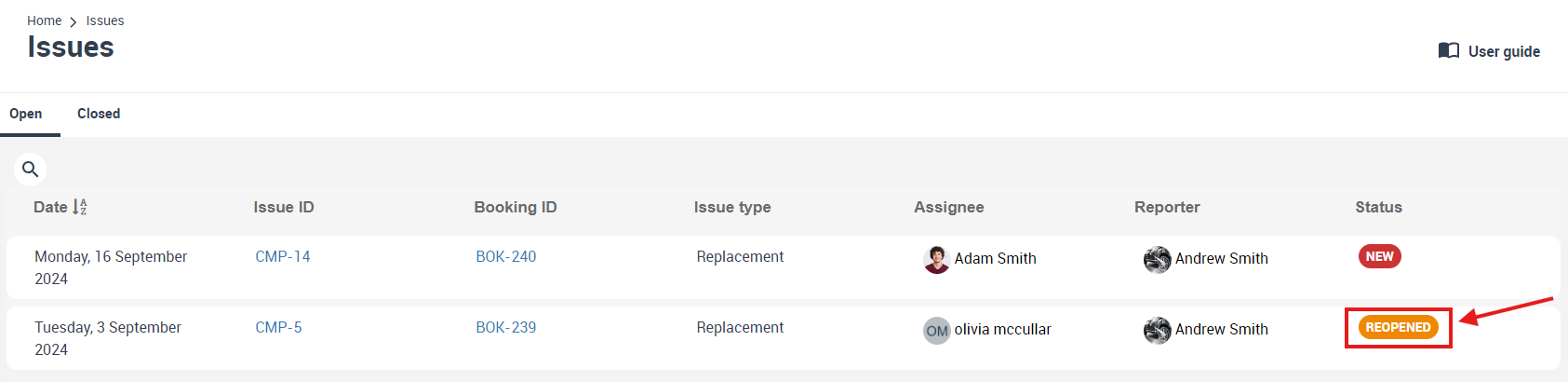
- Confirm it’s reopened:
- The issue becomes active again and will appear in your issues list as reopened/active.
What happens after you reopen an issue?
When you reopen an issue, OctopusPro restores it to an active resolution workflow. Depending on your setup:
- Status is updated automatically (commonly to a Reopened or In Progress-type status), so it’s clearly visible as requiring action.
- It returns to active queues, so office staff can triage and fieldworkers can take the required corrective action.
- Payment/processing safeguards may re-apply if your workflow withholds or pauses payment until issues are fully resolved and approved.
- Internal visibility remains intact, preserving the full history and audit trail from the original case plus new updates after reopening.
Reasons & examples
Reopening a complaint might be necessary in situations like:
- Incomplete resolution: the solution did not fully resolve the issue (e.g., an appliance was repaired and failed again soon after).
- New information: additional facts require further investigation (e.g., a delivery complaint becomes a missing-items complaint after arrival).
- Follow-up work required: the customer accepts the initial fix but requests rework to meet the agreed standard.
Benefits of reopening (for service quality & trust)
- Higher customer satisfaction: customers see you’re committed to a complete, fair resolution.
- Better accountability: reopened issues are trackable, assigned, and measurable—reducing “lost” complaints.
- Continuous improvement: repeated reopen reasons can highlight training gaps, process issues, or quality risks.
- Trust and transparency: a clear, auditable record reinforces professionalism and reduces disputes.
Best practices after reopening
- Record the reason for reopening in a short internal note (what changed and what’s needed next).
- Assign a clear owner (assignee) responsible for next steps and follow-up.
- Define the next action: request evidence, schedule a return visit, escalate to management, or apply a billing adjustment.
- Keep the customer updated to align expectations—especially if waiting on parts or scheduling constraints.
- Close the loop properly by moving the issue through your approval/closure workflow once resolved.
Related guides
- Customer Issue & Complaint Management (Overview)
- Add & Manage Issues & Complaints on Quotes, Bookings & Invoices
- Closing & Approving Resolved Issues
- Fieldworker Issue Resolution (Mobile App)
- Issues & Complaints History Log
To stay updated, please subscribe to our YouTube channel.