
Paragraph / Long Text Custom Field (Multi-Line Notes & Instructions)
The Paragraph / Long Text custom field (also known as a multi-line text field or text area) lets you capture detailed, open-ended information from customers, admins, or fieldworkers. Use it when the answer needs more than a short sentence.
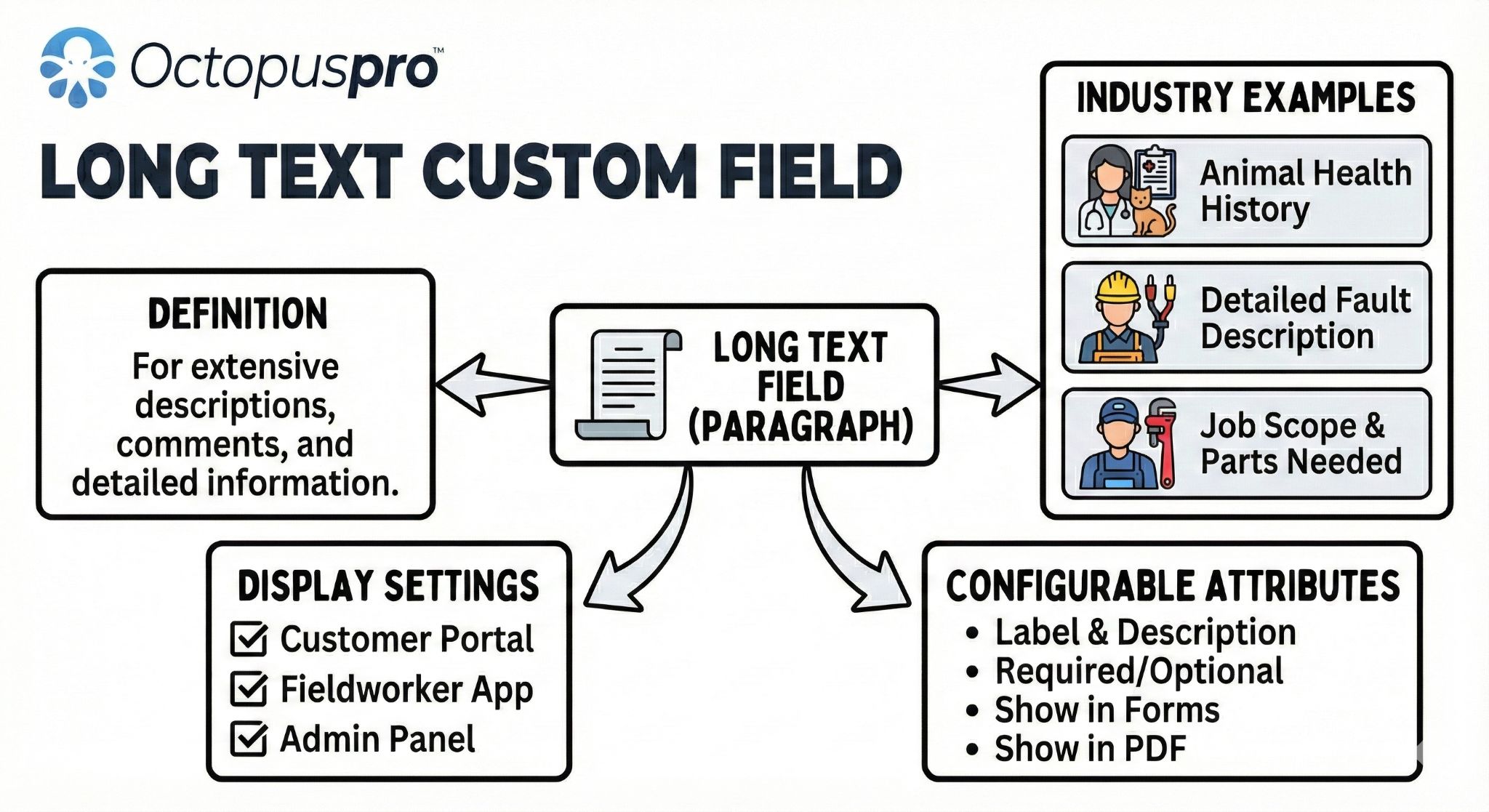
Common use cases:
- Access instructions (gate code, parking notes, key pickup, entry directions)
- Special requirements (site rules, “avoid this area”, pets on site, allergy/safety notes)
- Job scope description (what needs to be done, priority areas, known issues)
- Internal notes (handover notes between office staff and technicians)
- Profile notes (customer preferences, fieldworker bio/certifications—when stored on profiles)
Important: Paragraph/Long Text fields are designed for qualitative notes. When used as service booking questions, they typically do not adjust pricing or duration (unlike option-based fields such as steppers, toggles, dropdowns, radio buttons, etc.).
Quick navigation
- What this field is
- Where you can use it
- When to use it (and when not to)
- Benefits
- How to set it up
- Attach it to services (so it appears on inquiries/quotes/bookings)
- What admins, customers, and fieldworkers see
- Reporting, searching & exporting
- Best practices
- Troubleshooting
What this field is
A Paragraph/Long Text field displays as a multi-line text area so users can type or paste longer notes with line breaks preserved. It’s ideal for instructions and descriptions that can’t be captured reliably using structured options.
Where you can use it
You can add a Paragraph/Long Text field in different locations depending on what you want to capture:
- Service booking questions (recommended for job-specific notes): shown during inquiry, quote, and booking creation, and during online checkout (where enabled).
- Lead Capture (website inquiry widget): collect scope notes before a customer books, so your team receives better-qualified leads.
- Customer profile (CRM): store ongoing customer preferences (e.g., “parking instructions”, “preferred entry”, “billing notes”).
- Fieldworker profile: store longer internal notes (bio, certifications, equipment notes, languages).
- Forms & Checklists (separate feature): best for on-site reports, inspections, QA checklists, and compliance steps. Checklist fields are operational and typically do not affect pricing/duration.

For a full overview of custom fields across OctopusPro, see: Custom Fields (Booking, Lead Capture & CRM).

When to use it (and when not to)
Use Paragraph/Long Text when:
- You need customers/staff to explain something in their own words.
- The answer varies widely and can’t be standardized into options.
- You want to capture instructions that fieldworkers must read before starting.
Use a structured field instead when:
- You need consistent values for reporting (use dropdown/radio/button group).
- The answer should adjust price, duration, or packages (use option-based custom fields, such as toggle/stepper/radio, etc.).
- You want to show follow-up questions only when certain options are selected (use conditional logic / dependent fields).
Related setup guides: Custom Field Groups (Multi-Step Forms) and Dependent Custom Fields (Conditional Logic).


Benefits
- Fewer follow-ups: customers can provide full context upfront.
- Better job preparation: fieldworkers see instructions before arrival.
- Clear handover: office notes stay attached to the job record.
- Improved service quality: fewer missed details, less rework.
How to set it up
The exact path depends on where you want the field to appear, but the creation steps are similar.
A) Create a service booking Paragraph/Long Text field
- Go to Settings → Service Settings → Custom Fields.
- Click Create New (or + Add).
- Select Field Type: Paragraph / Long Text.
- Enter a clear Label (customer-facing), e.g., “Access instructions”.
- Add an optional Description / Helper text, e.g., “Include gate code, parking restrictions, and preferred entry.”
- Set Required or Optional.
- Choose where the field appears (where available), such as Admin, Customer Portal, and/or Fieldworker App, and whether to show in PDFs (where available).
- Click Save.
B) Create a Paragraph/Long Text field for Lead Capture (inquiry widget)
Use this when you want website visitors to provide a detailed job description before they book.
See: Lead Capture Form (Website Inquiry Form).
C) Create a Paragraph/Long Text field for CRM profiles
- Customer profile fields: Customer Profile Custom Fields

- Fieldworker profile fields: Fieldworker Profile Custom Fields

D) Need multi-line text inside Forms & Checklists?
If you’re building on-site checklists (inspections, QA, compliance, job reports), use Forms & Checklists instead of booking custom fields:


Attach it to services (so it appears on inquiries/quotes/bookings)
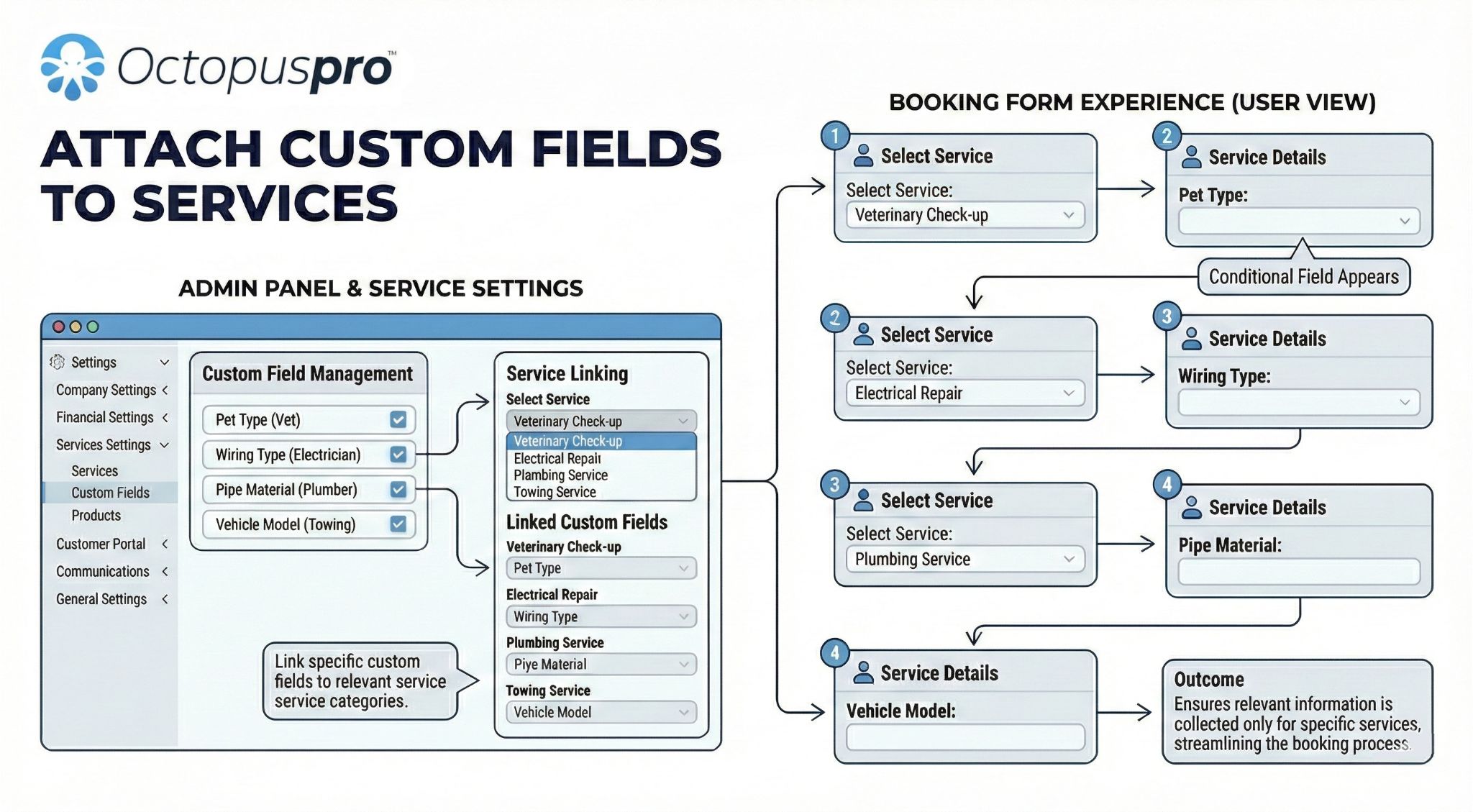
If you created the field under Service Settings → Custom Fields, you must attach it to the relevant service(s). Otherwise, it won’t show when that service is selected.
- Example: Attach an “Access instructions” paragraph field to your “End of Lease Cleaning” service.
- Now it can appear when creating an inquiry/quote/booking (and during Customer Portal checkout if enabled).
Step-by-step guide: Attach Custom Fields to Services.
What admins, customers, and fieldworkers see
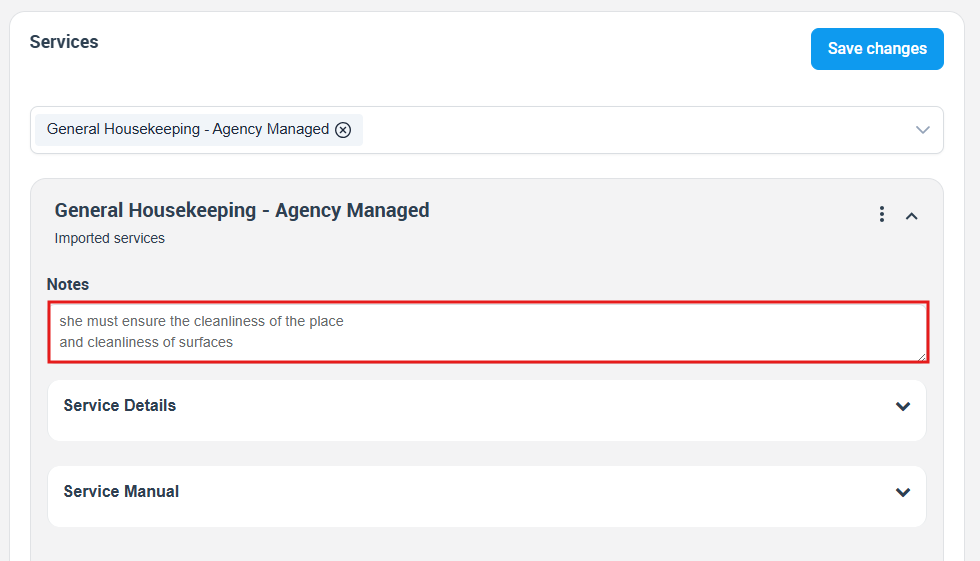
Admin console (web app)
Admins can enter and view long notes inside the booking/quote details. Line breaks are preserved so instructions remain easy to read.
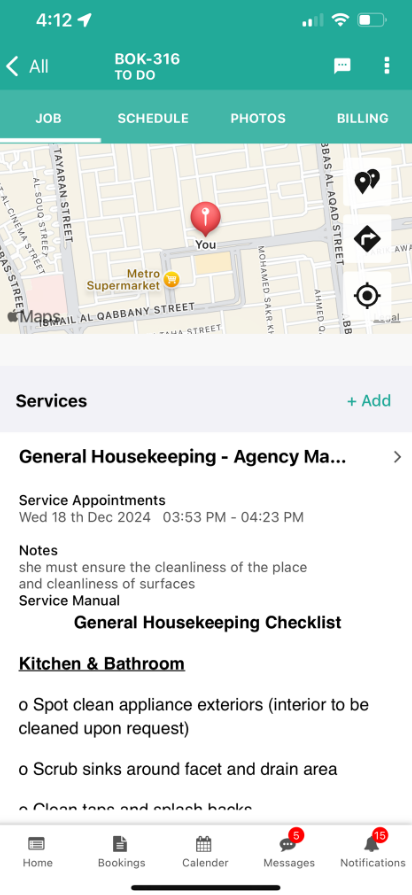
Fieldworker App
If enabled for fieldworkers, technicians can view (and depending on permissions, may be able to enter/edit) long-text notes for the job, helping them prepare before arrival.
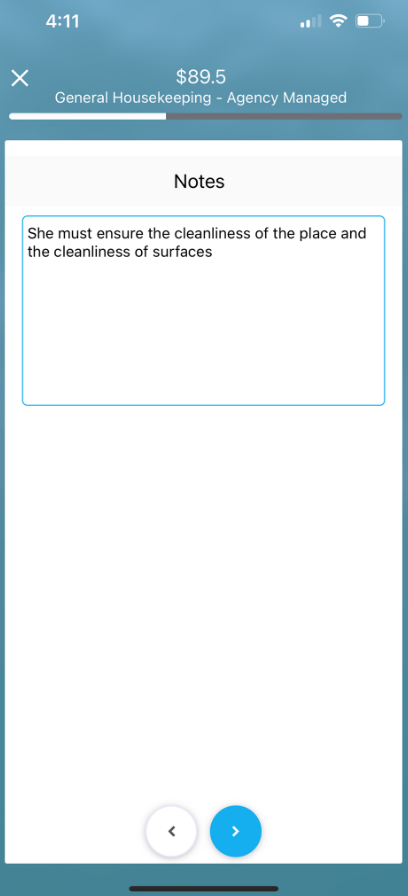
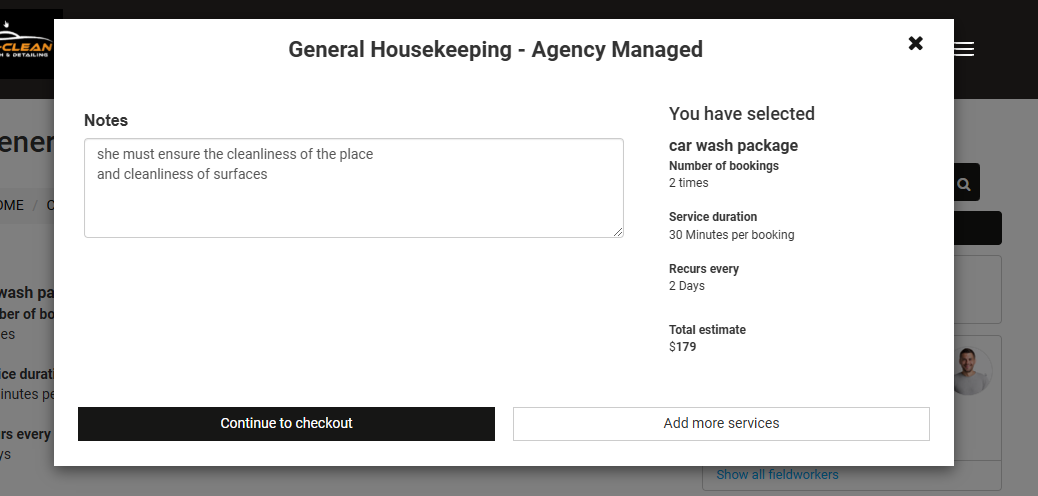
Customer Portal (online booking/checkout)
If enabled for customers, the paragraph field appears during online checkout so customers can add detailed instructions before submitting.
Reporting, searching & exporting
- Search: You can locate jobs using keywords found in the notes (e.g., “gate code”, “stairs”, “dog”).
- Exports: Where supported, long-text values can be included in exports for auditing and internal analysis.
- PDF visibility: If your field settings support “show in PDF”, you can include instructions in PDFs (quotes/bookings/invoices) to keep everyone aligned.
Best practices
- Use specific labels: “Access instructions” is clearer than “Notes”.
- Add helper text: Tell users what to include (gate codes, parking rules, preferred entry, etc.).
- Only make it required when necessary: Too many required fields can reduce form completion.
- Keep the booking flow clean: Use Custom Field Groups and Dependent Fields to show long-text questions only when relevant.
- Prefer structured fields for reporting: If you need consistent values, use dropdown/radio/button groups and reserve paragraph text for extra context.
Troubleshooting
- The field isn’t showing on a booking/quote: Confirm it’s attached to the service. See: Attach Custom Fields to Services.
- The field isn’t showing to customers: Check the field’s Customer Portal visibility setting (and that the service is available for online booking/checkout).
- The field isn’t showing to fieldworkers: Check the field’s Fieldworker App visibility setting and relevant permission/role settings.
Related articles
- Custom Fields (Booking, Lead Capture & CRM)
- Lead Capture Form (Website Inquiry Form)
- Attach Custom Fields to Services
- Custom Field Groups (Multi-Step Forms)
- Dependent Custom Fields (Conditional Logic)
- Forms & Checklists Overview
- Forms & Checklists Field Types/Elements
To stay updated, please subscribe to our YouTube channel.