
[vc_row][vc_column width=”1/4″][vc_widget_sidebar sidebar_id=”sidebar-1″][/vc_column][vc_column width=”3/4″][vc_column_text]
Minimum Notice Time (Advance Lead Time) for New Online Bookings

Use the Minimum Notice Time setting to control how soon customers can book an appointment through your Customer Portal. This prevents last-minute bookings, gives your team time to confirm availability, prepare equipment, or travel, and ensures your schedule stays realistic and operationally achievable.
This setting is especially useful for businesses that need preparation time (e.g., cleaning, trades, mobile services, wellness, events), or where bookings require manual review before dispatch.
Table of Contents
- What this setting does
- Before you start (quick checks)
- How to set the minimum notice time
- Notice time “starting from” options
- How to set time slot intervals
- Best practices
- Troubleshooting
- Use cases (examples)
- Related articles
What this setting does
When enabled, the system hides any appointment times that start within your configured minimum notice window. Customers will only see and select time slots that occur after the notice period has elapsed.
Example: If you set the minimum notice time to 120 minutes and the current time is 10:00 AM, the earliest time customers will be able to book is 12:00 PM (or later, depending on your time slot interval and availability).
Before you start (quick checks)
- Time Zone: Confirm your account time zone so “current time” calculations behave as expected. Update via Settings → General Settings → Date & Time Configuration.
- Working hours & availability: Ensure fieldworker/business working hours are configured correctly, because time slots are generated only inside available hours.
- Service duration: Ensure each service has a realistic duration, because longer services can block multiple time slots.
How to set the minimum notice time
- Go to Settings → Customer Portal → Flags & Permissions.
- Scroll to the Booking Flags section.
- Set a value for: “What is the minimum notice time required for any new bookings?” (in minutes).

After saving, only times that occur after the notice window will be shown to customers in the Customer Portal booking flow.

Notice time “starting from” options
You can choose how OctopusPro calculates the minimum notice window using: “Minimum notice time starting from”.

Option A: Current time
Counts forward from the current time (based on your account time zone configuration). Customers can’t book any start time that falls within the notice window.

Example: If notice time is 30 minutes and the current time is 2:45 PM, the earliest bookable time will be 3:15 PM (or later depending on time slot intervals and availability).
Option B: Beginning of working hours
Counts forward from the start of your working hours. This is useful when you want a consistent “earliest start time” each day.

Example: If working hours start at 8:00 AM and notice time is 30 minutes, the first available booking time would be 8:30 AM (subject to time slot intervals and availability).
How to set time slot intervals
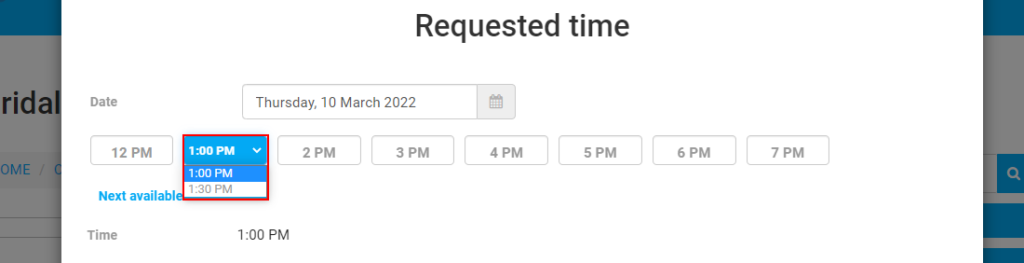
Time slot intervals define the step size between bookable start times (e.g., every 15 minutes, 30 minutes, 1 hour). This keeps customer selections aligned with how you actually schedule and dispatch work.
If no minimum notice time is set, customers may still see near-immediate times based on your time slot interval (e.g., 10:30 AM, 11:00 AM), as long as availability exists.

How time slot intervals behave
- Intervals run inside availability: Time slots start at the earliest available time and run until the end of the available window.
- Service duration is respected: If a customer books a longer appointment, overlapping start times are automatically blocked.
- Cleaner schedules: Intervals reduce overlaps and improve consistency for dispatching and capacity planning.
Steps to configure
- Go to Settings → Customer Portal → Flags & Permissions.
- Under Booking Flags, find Time slot intervals.
- Select your preferred interval (e.g., 15 minutes, 30 minutes, 1 hour).
Best practices
- Match operations: Set notice time to reflect your real prep/travel needs (e.g., 60–180 minutes for mobile services).
- Use 15-min intervals for high-frequency scheduling (e.g., clinics, salons); use 30–60 mins for field services.
- Combine with cancellation/reschedule rules: Notice time controls when customers can book; cancellation/reschedule settings control late changes.
- Keep your time zone accurate to avoid confusion when your team or customers operate across regions.
Troubleshooting
Customers can’t see any available times
- Check minimum notice time isn’t too high (e.g., 24 hours when you only have same-day availability).
- Confirm working hours & availability are set correctly (customers can’t book outside available hours).
- Confirm service duration isn’t consuming all remaining time blocks in the day.
- Check your time slot interval isn’t too large (e.g., 2–4 hours) for the schedule you expect.
- Verify your account time zone is correct (time calculations rely on it).
Customers can book, but times look “off”
- Review Date & Time Configuration (time zone + time format).
- Confirm the “starting from” mode is set appropriately (Current time vs Beginning of working hours).
Use cases (examples)
Beauty Care Salon: Beauty & More (step-by-step example)
Scenario: Working hours are 8:00 AM to 5:00 PM. The business wants a 30-minute lead time for any new booking.
- In Settings → Customer Portal → Flags & Permissions, set “What is the minimum notice time required for any new bookings?” to 30 minutes.

- Select Minimum notice time starting from → Current time (for same-day lead time).

Result: If the customer is booking at 2:45 PM, the earliest available time shown will be 3:15 PM (or later depending on intervals and availability).

- Set Time slot intervals (e.g., 15 minutes) to offer customers finer time selections.


More common examples
- Trades & maintenance: Set a 2–4 hour lead time so you can confirm materials, access, and dispatch.
- Mobile services: Use Current time + 60–180 minutes to account for travel and route planning.
- Appointments & clinics: Use 15-minute intervals + 30–60 minutes notice to reduce short-notice bookings and no-shows.
Related articles
- Customer Portal Flags & Permissions
- Date & Time Configuration (Time Zone)
- Fieldworker Working Hours & Availability
- Time Slot Intervals (Dedicated Guide)
- Minimum time required before customers can cancel/reschedule
To stay updated, please subscribe to our YouTube channel.
[/vc_column_text][/vc_column][/vc_row]