
Time Slot Intervals for Customer Portal Bookings

Time slot intervals define the start-time increments customers can choose when booking through your Customer Portal. In other words, they control the “step size” of bookable times (e.g., every 15 minutes, 30 minutes, 1 hour, etc.).
For example, if your interval is set to 30 minutes, customers can choose start times like 1:00 PM, 1:30 PM, 2:00 PM, 2:30 PM, and so on (as long as the fieldworker is available at those times).
What this setting controls
- Customer selection granularity: smaller intervals offer more time choices; larger intervals simplify schedules.
- Operational consistency: keeps customer requests aligned with how you dispatch and plan work.
- Availability-aware booking: time slots are generated inside each fieldworker’s working hours and availability.
Why time slot intervals matter
- Cleaner schedules: consistent increments reduce “awkward” start times and make calendars easier to manage.
- Fewer overlaps: OctopusPro automatically blocks start times that would conflict with existing bookings.
- Better customer experience: customers can quickly pick from realistic times instead of requesting custom times.
How time slot intervals work
1) Time slots run inside availability
Time slots start at the earliest available time for the fieldworker and continue until the end of their available window. For example, if a fieldworker is available from 9:00 AM to 5:00 PM and your interval is 1 hour, customers can request 9:00, 10:00, 11:00, and so on.
2) Booking duration is respected
Time slot intervals also account for the service duration (and any time already booked). If a customer books a longer appointment, any overlapping start times become unavailable.
Example: With a 30-minute interval, a 1-hour booking starting at 1:00 PM blocks overlapping start times (e.g., 1:30 PM) until the booking finishes.
3) If there isn’t enough time left, times won’t be shown
If the service duration exceeds the remaining available time in the day, that time (or the day) may not show as bookable. This prevents customers from requesting times that cannot fit within availability.
How to set time slot intervals
Configure time slot intervals from your Customer Portal booking settings:
- Go to Settings → Customer Portal → Flags & Permissions.
- Scroll to the Booking Flags section.
- Find Time slot intervals and select your preferred interval (e.g., 15 minutes, 30 minutes, 1 hour).
- Click Save.

How customers see time slot intervals in the Customer Portal
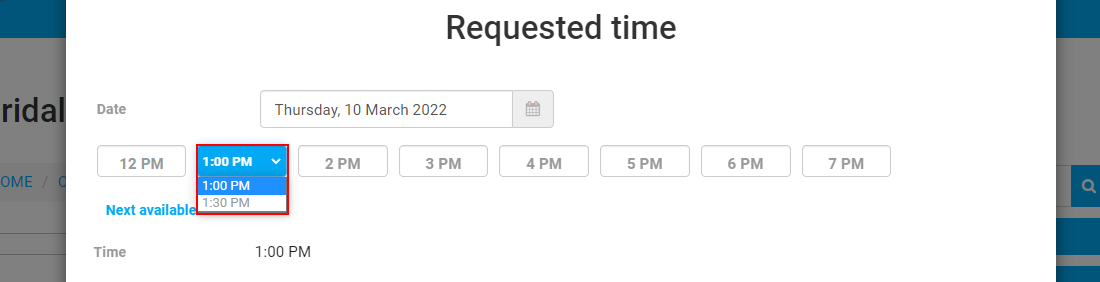
Once saved, your selected interval is reflected during portal checkout under the Requested time step. Customers will be able to choose from available times that match your interval.
Example: With a 30-minute interval, the time drop-down will show options like 1:00 PM, 1:30 PM, etc., for each available hour.
How to choose the best interval
The right interval depends on how precisely you schedule work and how predictable your job durations and travel times are. Use these common guidelines:
- 15 minutes: high-frequency appointments (e.g., clinics, salons, short visits).
- 30 minutes: most appointment-based services (a good balance of choice and simplicity).
- 60 minutes (1 hour): longer onsite work, route-based services, and trades where start times are typically hourly.
- 2–4 hours: large jobs or “arrival window” style operations where exact times are less important.
Tip: If you allow customers to select an exact start time, the interval controls the available time options. If you use time windows (part-of-day) instead, customers select a window rather than minute-based times.
Best practices
- Match operations: pick an interval that matches how your dispatch team plans the day (don’t offer precision you can’t reliably deliver).
- Keep availability accurate: update fieldworker working hours, blocked times, and time off so customers only see realistic options.
- Combine with lead time: set a minimum notice (lead time) to prevent last-minute bookings that you can’t prepare for.
- Check your time zone: booking times rely on your account time and availability configuration.
Troubleshooting
- Customers can’t see any times: confirm fieldworker working hours/availability are set and the service duration fits within the available window.
- Too few options: a larger interval reduces the number of selectable times. Consider a smaller interval (e.g., 60 → 30 minutes).
- Times start “too late”: check your minimum notice (lead time) settings, which can hide near-term time slots.
- Times look incorrect: verify your account time zone and availability rules.
FAQ
What are time slot intervals?
Time slot intervals are the configurable increments between bookable start times in the Customer Portal (e.g., every 15, 30, or 60 minutes).
Can customers still book longer appointments with shorter intervals?
Yes. A shorter interval controls start-time options, not the maximum appointment duration. If a longer booking is made, overlapping start times are automatically blocked until the booking ends.
Do time slot intervals depend on working hours?
Yes. Time slots are generated inside each fieldworker’s available hours, starting from the earliest available time and running to the end of availability.
Related guides
- Customer Portal Flags & Permissions
- Fieldworker Working Hours & Availability
- Minimum Notice Time (Lead Time)
- Allow Customers to Select Booking Times
- Dynamic Real-time Fieldworker Availability Scheduling
To stay updated, please subscribe to our YouTube channel.