
Attach Custom Fields to Services
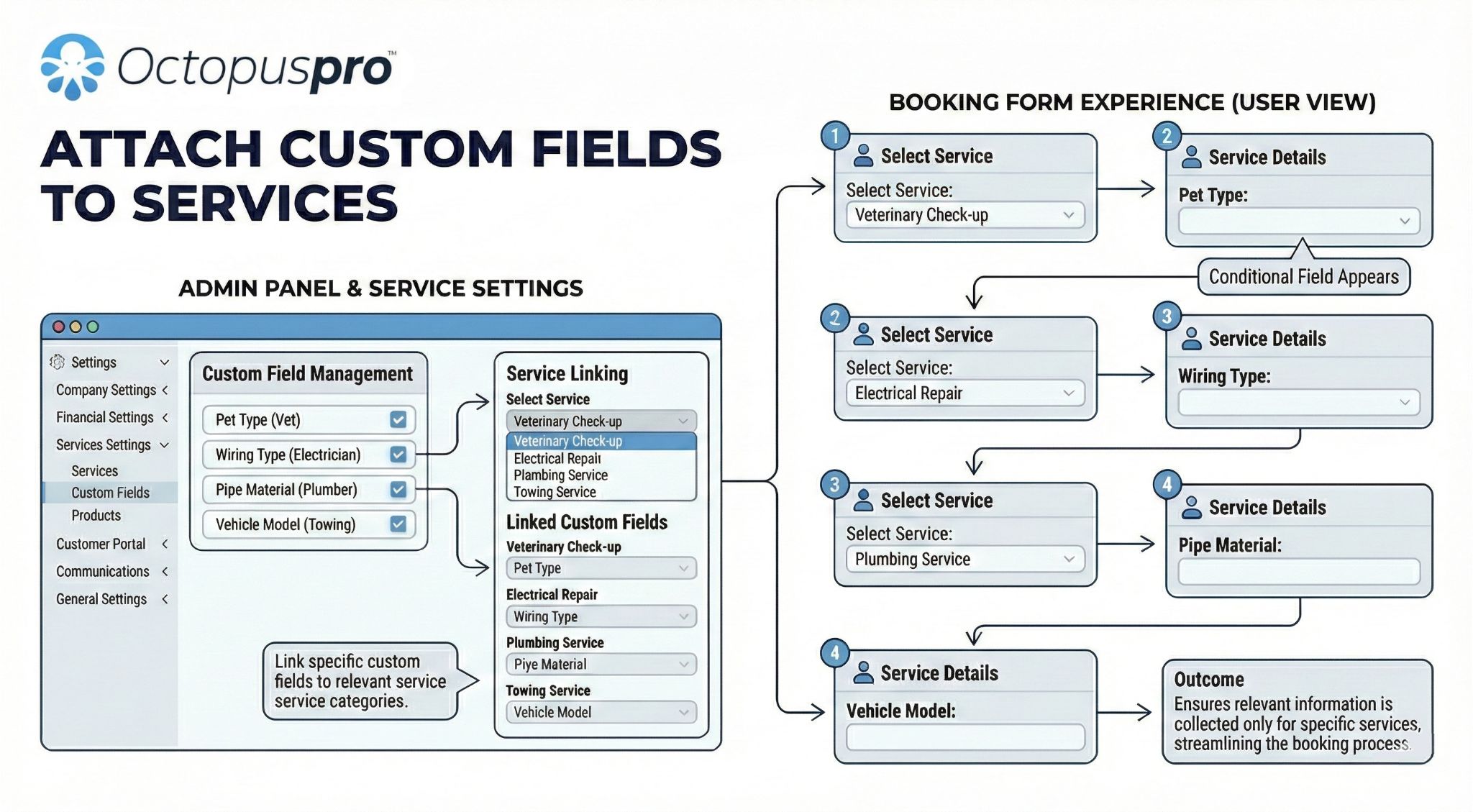 Custom fields are additional service questions, options, and add-ons you use to collect the details needed to quote and deliver a job correctly. To show the right questions for the right service, you must link (assign) custom fields to services.
What linking custom fields to services is used for
- Accurate job scoping: collect site details, requirements, access notes, measurements, preferences, and photos upfront.
- Better quoting: selections can optionally add extra cost and/or extra duration when configured.
- Cleaner operations: admins and fieldworkers see the service requirements clearly on the job record.
- Faster booking flow: customers only see the questions that apply to the service they selected.
Where custom fields will appear
- Customer Portal / Branded App: customers answer custom fields during online booking.
- Admin Portal: admins see and complete custom fields when creating/editing bookings, quotes, or inquiries manually.
- Fieldworker App: fieldworkers can review answers before and during the job.
How linking works (important)
Custom fields and services have a many-to-many relationship:
- You can link multiple custom fields to one service.
- You can link the same custom field to multiple services (recommended for reuse and consistency).
Tip: Build a reusable library of fields such as “Access instructions”, “Parking”, “Pets on site”, “Before/after photos”, then link them only where needed.
Before you start (recommended)
- Make sure the service exists (or create it first).
- Create your custom fields first (or create them from inside the service editor).
- Decide whether each field should be required and whether it should be visible to customers and/or shown on invoices.
Key custom field settings (quick explanation)
- Field label: what users see (can be a question like “Specify your car’s make and model”).
- Field ID: internal unique identifier (useful when labels are similar).
- Helper text: short guidance shown with the field to improve answer quality.
- Mandatory (Required): users must answer to continue.
- Visibility controls: hide fields from Customer Portal/Branded App or inquiry-only forms when needed.
- Invoice visibility: you can hide booking-only fields from invoice breakdown using Hidden from invoice breakdown.
- Searchable: enable only for fields you need to search/report by (e.g., vehicle rego, serial number).
How to link custom fields to services (3 methods)
The screenshots on the OctopusPro help pages show the exact buttons and pop-ups you will see in the admin portal.
Method 1: Bulk link from the Custom Fields list (best for reuse)
Use when: you already created the custom field and want to link it to one or more services.
- Go to Settings ▸ Service Settings ▸ Custom Fields.
- Tick the checkbox beside the custom field you want to link.
- Click Connect to services (in some accounts it may appear as Assign a custom field to a service).
- In the pop-up window, select the service(s) you want to link.
- Click Save.

Edit later: Use the option on the field row (for example Modify Services) to add/remove linked services, then save.
Method 2: Create a new custom field from a service (Add/Edit Service)
Use when: you’re configuring a service and want to create brand-new questions at the same time.
- Go to Settings ▸ Service Settings ▸ Services.
- Click Edit beside the service.
- Open the Custom Fields step/tab.
- Click Add New and choose Create new custom field.
- Complete the field setup and click Save.
- Save the service changes.


Method 3: Add an existing custom field from a service (Add/Edit Service)
Use when: you want to reuse an existing field on this service.
- Go to Settings ▸ Service Settings ▸ Services.
- Click Edit beside the service.
- Open the Custom Fields step/tab.
- Click Add New and choose Add existing custom field.
- Select the field from the pop-up list and click Add.
- An Edit custom field pop-up may appear—review settings and save.
- Save the service changes.


Improve the booking flow with Custom Field Groups (multi-step booking forms)
If a service has many questions, you can split them into multiple steps in the Customer Portal/Branded App. This makes the form easier to complete (especially on mobile).
Create a Custom Field Group
- Go to Settings ▸ Service Settings ▸ Custom Fields.
- Select the fields you want to include in one step.
- Click Manage Groups → Create a new Group.
- Set:
- Group label: step title (e.g., “Site details”).
- Helper text (optional): short guidance line.
- Fields: confirm which fields belong to this group.
- Click Save.
Edit a group
- Go to Settings ▸ Service Settings ▸ Services.
- Open the Custom Field Groups tab.
- Click Edit, update, then click Update.
Use Dependent Custom Fields (conditional logic)
Dependent fields (conditional logic) display follow-up questions only when a specific answer is selected. This keeps booking forms short and relevant.
How to configure dependent fields
- Go to Settings ▸ Service Settings ▸ Services ▸ Custom Fields.
- Edit the parent field.
- Under the option you want to branch from, click + Add dependent field.
- Select the follow-up field from the dropdown.
- (Optional) configure Price Adjustment and/or Extra Duration that applies when the dependent field is triggered.
- Save.
Pricing transparency options (Customer Portal)
Option A: Show custom field add-on pricing on the service view page (optional)
This displays a pricing list for custom field add-ons on the service view page in the Customer Portal before the customer starts booking.
- Go to Settings ▸ Customer Portal ▸ Flags & Permissions.
- Enable: Display pricing of custom fields added to each service on the service view page.
- Save.
Important: The custom field itself must also be configured to allow pricing to display on the service view page (toggle must be enabled inside the custom field settings).
Option B: Show the full service and custom field pricing structure to customers (optional)
This allows customers to view the full pricing list of the service they are going to book.
- Go to Settings ▸ Customer Portal ▸ Flags & Permissions.
- Enable: Display service and custom field pricing structure to customers.
- Save.
Fieldworker eligibility (optional, but recommended if you filter jobs by options)
If you use custom field options to control which fieldworkers are eligible for certain work (skills-based scheduling, auto-dispatch, preferences), ensure the relevant custom field values are enabled for fieldworkers where applicable.
- You can enable custom fields (and their values) for all fieldworkers from Service Settings after creating or editing a custom field.
- You can also edit a specific fieldworker’s allowed values for a service from the fieldworker profile (service provided → edit custom field values).
Troubleshooting
- Field not showing in booking: confirm the field is linked to the exact service selected and not hidden from the Customer Portal/Branded App.
- Field shows on the wrong service: remove it using Modify Services (or the service’s Custom Fields tab).
- Pricing list not showing on service view page: confirm the Customer Portal flag is enabled AND the custom field is configured to display pricing on the service view page.
- Field not appearing on invoices: check whether Hidden from invoice breakdown is enabled for that custom field.
- Too many questions: use Custom Field Groups (multi-step) and Dependent fields (conditional logic).

Related guides
- Custom Fields (Booking, Lead Capture & CRM Data)
- Dependent Custom Fields (Conditional Logic)
- Display Pricing of Custom Fields
- Display Service & Custom Field Pricing Structure
- Customer Portal Flags & Permissions
For more walkthroughs, visit the OctopusPro User Guide and subscribe to the OctopusPro YouTube channel.
To stay updated, please subscribe to our YouTube channel.