
[vc_row][vc_column width=”1/4″][vc_widget_sidebar sidebar_id=”sidebar-1″][/vc_column][vc_column width=”3/4″][vc_row_inner][vc_column_inner][vc_column_text]
Empower Fieldworkers: Accept or Decline Job Requests

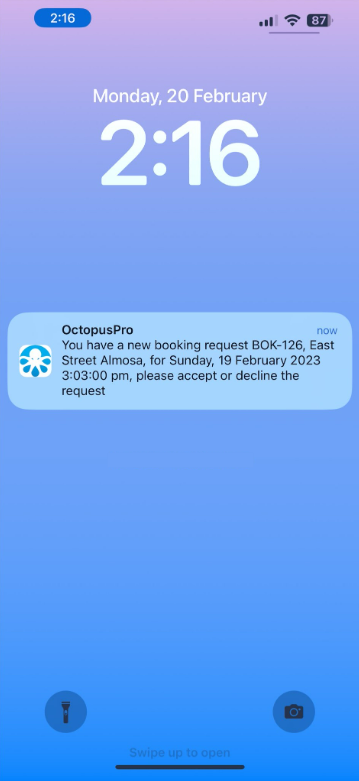
OctopusPro offers administrators the flexibility to control whether fieldworkers can accept or decline booking requests. This functionality is pivotal in balancing operational efficiency with fieldworker autonomy. By configuring this setting, businesses can streamline job assignments, reduce scheduling conflicts, and enhance overall service delivery.
Benefits of Enabling Fieldworker Booking‑Request Permissions
Giving fieldworkers the ability to Accept or Decline pushes time‑critical decisions to the edge, speeding confirmations, preventing calendar clashes, and feeding dispatch with high‑quality data to optimize staffing, skills, and training.
- Faster, cleaner scheduling. Job requests can be broadcast to all eligible fieldworkers by push/SMS/email; the first qualified Accept can be auto‑assigned, cutting phone‑tag and locking the slot immediately.
- Fewer last‑minute cancellations. Fieldworkers decline clashes before they hit the calendar, while real‑time availability and optimization engines avoid sending offers to unavailable or poorly matched resources.
- Alternative‑time suggestions & auto‑rebooking. On Decline, you can require the tech to propose alternate slots; those options go to the customer by email/SMS, and the job can be re‑broadcast to qualified, available techs until one accepts—preserving the customer’s preferred fieldworker where possible and reducing lost jobs.
- Higher fieldworker satisfaction & retention. Autonomy over workload is a well‑documented driver of morale and retention; modern FSM combines central control with fieldworker autonomy for best results.
- Lower admin workload. Self‑selection and instant notifications reduce back‑office chasing and manual rescheduling, freeing staff for higher‑value tasks.
- Right tech, right job. Captured decline reasons (distance, skill/licence gap, equipment, safety) reveal patterns that guide territory adjustments, certification plans, and inventory decisions.
- Stronger first‑time‑fix rate (FTFR). Matching work orders to appropriately skilled and prepared fieldworkers is one of the biggest levers for improving FTFR and customer satisfaction.
- Scalable capacity with subcontractors. Broadcast to part‑time/overflow crews in peak periods to add capacity without permanent headcount.
- Customer transparency (configurable). Optional customer notifications when an assigned tech declines maintain trust while the system reassigns; you can also keep notifications off to avoid unnecessary concern. (Real‑time visibility & audit trail. Push alerts drive faster fieldworker responses, and every accept/decline is logged for KPIs and compliance.
- Works with Automatic or Manual assignment. Use Automatic for first‑accept wins at scale, or Manual when you want dispatch to review responders and pick the best fit—both patterns are standard in modern FSM.
Configuring Fieldworker Booking Request Permissions
To Enable or Disable the Feature:
- Navigate to Settings > General Settings > Fieldworker Permissions.
- Locate the toggle labeled “Allow Fieldworkers to Accept and Decline Booking Requests”.
- Switch the toggle ON to enable or OFF to disable the feature.
Note: When disabled, all booking requests sent to fieldworkers are automatically accepted, and they will not have the option to decline any assigned bookings.
Use Cases
1) Licence‑gated compliance work (electrical upgrade)
What happens
A customer requests a switchboard upgrade. Apprentices receive the request but tap Decline – licence required. A licensed electrician accepts and is auto‑assigned.
Features used → Outcome
- Accept/Decline permission + Automatic Assignment → unlicensed techs step back, first licensed Accept wins and is scheduled instantly.
- Decline‑reason form → reason is logged for compliance and training reports. (Fieldworker Permissions, Customize Fieldworker Job Decline Reason Form)
2) Safety risk with evidence & fast recovery
What happens
A roofer arrives to high winds, taps Decline – safety risk, uploads a photo, and proposes two alternates. Dispatch is alerted; the customer receives those options, or the job is re‑broadcast to matched techs.
Features used → Outcome
- Decline form (photos enabled) + Reschedule Assist → evidence captured, alternates collected at the point of decline. (Fieldworker Reschedule Assist – Automated Alternate Slot Suggestions & Rebooking)
- Customer notifications (optional) + Auto re‑broadcast on decline (Automatic Assignment) → immediate customer choices, rapid reassignment if needed. (Customize Fieldworker Job Decline Reason Form, Booking Settings, Flags and Permissions)
3) Assigned tech backs out — schedule auto‑recovers
What happens
An already‑assigned technician declines due to an overrun. The booking flips to Pending, OctopusPro re‑broadcasts to all matched fieldworkers, and (if enabled) the customer is notified automatically. First to accept is reassigned.
Features used → Outcome
- Automatic Assignment re‑broadcast loop + Notifications for Declined Bookings → minimal downtime, transparent customer comms.
- Status automation → full audit trail of Accept/Decline and reassignment. (Booking Settings, Fieldworker Permissions)
4) Peak‑season surge covered by subcontractors
What happens
Heatwave drives AC breakdown calls. The office enables Automatic Assignment and broadcasts to employees and approved subcontractors; the first qualified Accept wins each job.
Features used → Outcome
- Automatic Assignment + multi‑channel notifications (push/SMS/email) → faster confirmations without adding permanent headcount.
5) Stop “ghost” jobs with forced acknowledgement
What happens
To prevent unacknowledged requests, the Pending‑Booking Accept/Decline Alarm shows a full‑screen prompt and repeats every 5 minutes until the tech taps Accept or Decline.
Features used → Outcome
- Accept/Decline Alarm → every new assignment is acknowledged; dispatch gets early warnings; schedules stay accurate. (Booking Settings, Flags and Permissions, Fieldworker Job Alarms, Alerts & Reminders)
6) Real‑time availability prevents bad pings
What happens
A same‑day booking is created. Dynamic Real-time Fieldworker Availability Scheduling checks calendars and pings only technicians who are actually free and qualified.
Features used → Outcome
- Real‑time availability + skills/eligibility matching → fewer declines, faster confirmations, higher on‑time arrival.
- Admins can disable per booking when necessary (e.g., emergencies).
7) Keep the customer’s preferred technician
What happens
A senior electrician can’t make the original slot and taps Decline with three alternates. The customer receives those choices; choosing one rebooks with the same tech. If none fit, the office re‑broadcasts to the pool.
Features used → Outcome
- Reschedule Assist + customer messaging → higher save rate for at‑risk jobs, lower cancellations, better CSAT.
- Automatic Assignment re‑broadcast as fallback. (Fieldworker Reschedule Assist – Automated Alternate Slot Suggestions & Rebooking)
8) Manual triage for complex, multi‑day work
What happens
For a high‑stakes installation, dispatch uses Manual Assignment. Several techs tap Accept; they all show Accepted, but the job remains Unassigned until the dispatcher reviews cost, proximity, ratings, and licences and clicks Assign job.
Features used → Outcome
- Manual Assignment → office retains control on critical projects; candidates visible in the Accepted list with one‑click Assign job.
9) Admin override rescues stalled requests
What happens
A driver is in transit and can’t respond. The dispatcher uses Admin Override to accept on their behalf so the customer receives a fast confirmation; the action is logged.
Features used → Outcome
- Admin override of booking requests → protects SLAs; audit trail maintains accountability. (Accept, Decline, or Pend Bookings on Behalf of Fieldworkers)
10) Data reveals territory, skills, and inventory gaps
What happens
Reports show many declines tagged Address outside service area and Licence missing. Ops redraws geo‑fenced service areas, prioritises certification, and stages spare parts in the region. Acceptance rates rise the next month.
Features used → Outcome
- Decline‑reason analytics → pattern insights for territory tuning, training plans, and inventory decisions. (Customize Fieldworker Job Decline Reason Form)
11) Rapid quoting with the Availability Finder
What happens
A phone enquiry comes in. The agent opens Fieldworker Availability Finder, which ranks the best‑qualified, nearest, soonest‑available tech. The agent offers that slot and dispatches immediately.
Features used → Outcome
- Availability Finder → eliminates guesswork, trims travel, shrinks wait windows, boosts first‑time resolutions.
12) Privacy‑first address handling
What happens
For sensitive jobs, the business hides the full address until a request is accepted. Techs see suburb and time window to evaluate; after Accept, the full address and contacts unlock.
Features used → Outcome
- Address‑visibility control + Accept/Decline permission → protects customer privacy without slowing dispatch. (Handling New Job Requests and Booking Assignments as a Fieldworker)
Job Request Process: How Fieldworkers Receive and Respond to Job Requests

OctopusPro offers a flexible and efficient system for dispatching job requests to fieldworkers. Administrators can choose between automatic and manual methods to assign jobs, ensuring optimal alignment with business operations.
1. Automatic Job Assignment
Automatic Job Assignment can be enabled from Settings > General Settings > Job Assignment.
When the Automatic Job Assignment feature is enabled, the system streamlines the dispatch process:
- Triggering Job Requests: Upon a customer’s booking via the customer portal, OctopusPro automatically identifies eligible fieldworkers based on predefined criteria such as skills, location, and availability.
- Real-Time Availability Check: If the Real-Time Availability feature is activated, the system cross-references fieldworkers’ live calendars to ensure they are available during the requested time slots.
- Notification Dispatch: Eligible fieldworkers can receive job request notifications through multiple channels, including:
- Push notifications via the mobile app
- SMS messages
- Emails
- Job Acceptance: The first fieldworker to accept the job is automatically assigned, and the booking details are updated accordingly.
2. Manual Job Assignment
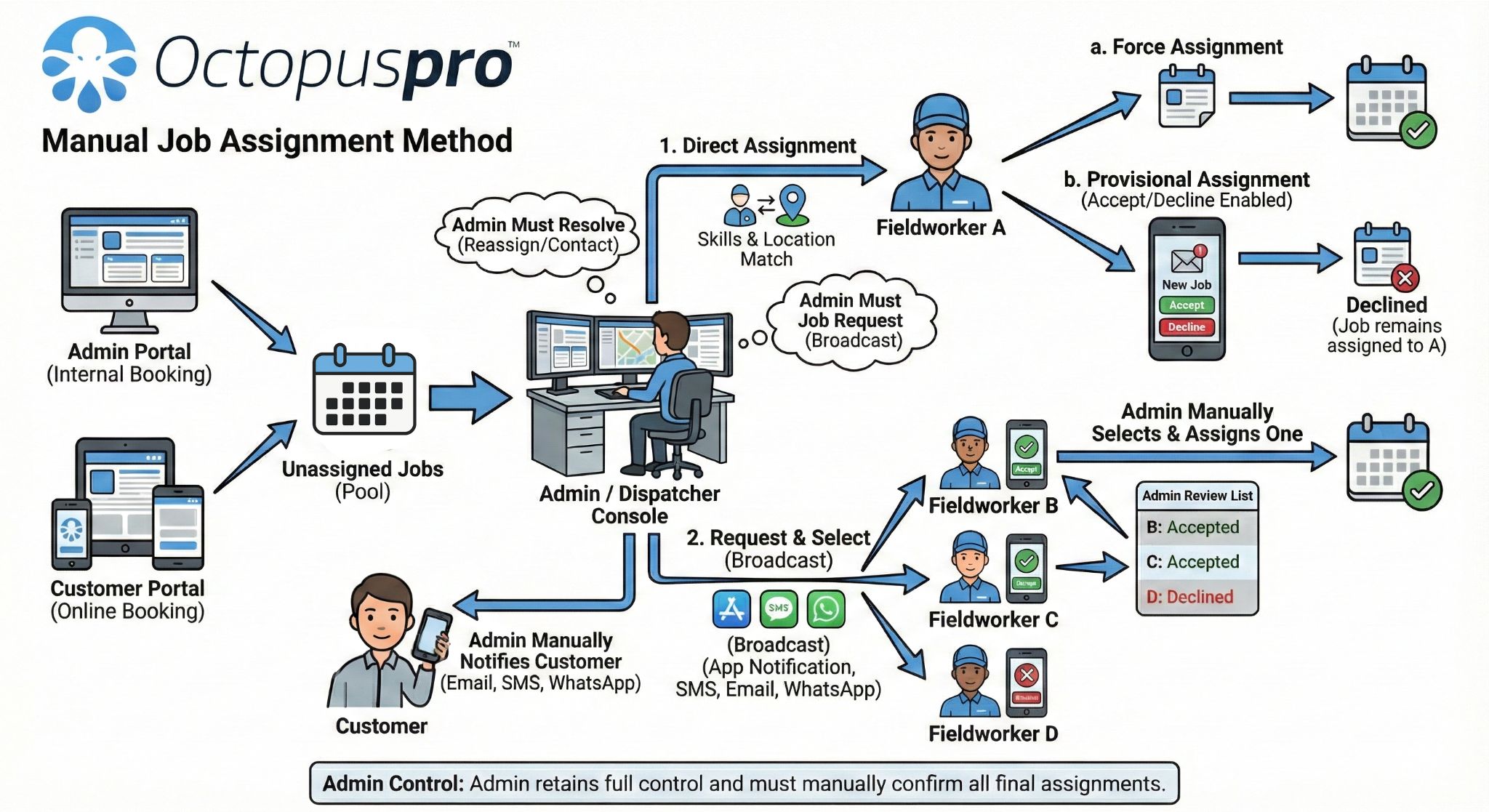 For greater control, administrators can opt for manual job assignment:
- Initiating Job Requests: Administrators can manually send job requests to selected fieldworkers from the booking management page.


- Fieldworker Response: Fieldworkers receive notifications similar to the automatic method and can choose to accept or decline the job.
- Finalizing Assignments: Administrators review the responses and assign the job to the most suitable fieldworker based on factors like availability, proximity, and expertise.
3. Configuring Real-Time Availability
To ensure job requests are sent only to available fieldworkers:
- Enable Real-Time Availability:
- Navigate to Settings > Customer Portal > Flags & Permissions.
- Activate the Enable real-time availability flag under the fieldworker settings.
- Benefits:
- Prevents scheduling conflicts by considering fieldworkers’ current availability.
- Enhances customer satisfaction by reducing the likelihood of rescheduling.
4. Managing Job Request Notifications
Fieldworkers receive comprehensive job details in their notifications, including:
- Job type and description
- Location (with privacy considerations)
- Scheduled date and time
- Estimated duration
Note: To maintain customer privacy, full contact details and exact addresses are initially withheld. These details become accessible to the fieldworker upon job acceptance.
- Adjusting Address Visibility:
- To display full booking addresses at all times, go to Settings > Fieldworker Permissions.
- Enable the Display the full booking address to fieldworkers at all times flag.
5. Fieldworker Interaction with Job Requests
Upon receiving a job request, fieldworkers can:
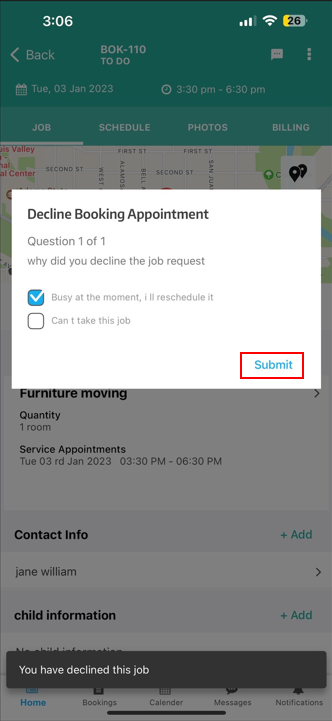
- Accept: The job request status is updated to “Accepted” and the job is added to their schedule, and they receive all pertinent details depending on permissions.
- Decline: They may be prompted to provide a reason for declining, which assists administrators in understanding and addressing potential issues.
- Suggest Alternative Times: If enabled, fieldworkers can propose different time slots, facilitating rescheduling without losing the job.
6. Monitoring Job Request Status
Administrators can track the status of job requests in real-time:
- Accessing Job Requests:
- Navigate to the Job Requests Dashboard to view all pending, accepted, and declined requests.
- Analyzing Responses:
- Utilize filters to sort job requests by status, fieldworker, or date.
- Review decline reasons to identify patterns or recurring issues.
- Taking Action:
- Reassign declined jobs promptly to ensure service continuity.
- Communicate with fieldworkers for clarification or to address concerns.
Best Practices
- Monitor Decline Reasons: Regularly review the reasons provided by fieldworkers for declining jobs to identify trends and address any underlying issues.
- Customize Decline Forms: Tailor the decline reason form to capture relevant information, aiding in better decision-making and resource planning.
- Communicate Expectations: Ensure fieldworkers understand the importance of timely responses to booking requests to maintain service standards.
FAQs
What if several fieldworkers hit Accept on the same booking?
| Assignment Mode | System Behaviour | What you (admin) need to do |
|---|---|---|
| Automatic Job Assignment | The first fieldworker to tap Accept is locked in; any later attempts trigger a banner: “This booking has already been assigned.” | Nothing—dispatch is complete and the job appears in the winner’s calendar. |
| Manual Job Assignment | Every responder’s status changes from Pending ➜ Accepted but the booking stays un-assigned until manually assigned by admin through Available Fieldworkers › Assign Job. | Review the Accepted list and click Assign for your preferred fieldworker; the others are automatically released. |
What if an assigned fieldworker later taps Decline?
| Assignment mode | What OctopusPro does | What you can configure / do |
| Automatic Job assignment | 1) Sets the booking back to Pending. 2) Immediately re-issues the job request to all matched fieldworkers so the “first to accept” loop can run again. 3) Sends an alert to the office. | • Toggle Notifications for Declined Bookings (Settings › General Settings › Job Assignment) to decide whether customers also receive an email/SMS about the change. |
| Manual Job assignment | Removes the job from the fieldworker’s calendar, flags it Declined on the overview, and alerts admins. | From Available Fieldworkers choose Send Request (to poll all matches again) or Assign Job (to give it straight to a backup fieldworker). |
Tip: reasons entered in the decline form are logged for auditing and can highlight training or coverage gaps.
By effectively managing the “Allow Fieldworkers to Accept and Decline Booking Requests” feature, administrators can strike a balance between operational efficiency and fieldworker autonomy, leading to improved service delivery and employee satisfaction.
Best-Practice Checklist for Fieldworkers
| ✔️ Action | Why it Matters |
|---|---|
| Respond within minutes—tap Accept or Decline as soon as the push/SMS/email arrives. | Fast confirmations let dispatch lock the slot and avoid double-booking. |
| Always give a decline reason (e.g., conflict, distance, skill gap) and, if enabled, propose an alternate slot. | Clear feedback fuels better auto-routing and shows customers you’re still keen to help. |
| Keep your calendar accurate—block PTO, training, or personal errands as soon as they’re known. | Real-time availability filters out jobs you can’t take, slashing reschedule churn. |
| Monitor the “New Requests” screen a few times each shift. | Ensures no request slips past silent-notification dead zones. |
| Sync with dispatch on any mid-day changes (traffic, over-runs, emergencies). | Live updates let ops reshuffle jobs before customers are affected. |
| Review job details before accepting—check location, duration, required equipment, licences. | Prevents on-site surprises and elevates first-time-fix rate. |
| Maintain your skills & certification tags in the app profile. | Accurate tags keep mismatched jobs out of your queue and highlight up-skilling needs. |
| Aim for a high Job Acceptance Rate (JAR). | Companies correlate 85 %+ JAR with faster scheduling and higher CSAT. |
Following this checklist minimises last-minute cancellations, lightens admin workload, and positions you as the go-to tech for future high-value bookings.
Alternative Availability Suggestions (when a fieldworker declines)
Fieldworker Reschedule Assist is OctopusPro’s auto-rescheduling layer: when a fieldworker taps Decline, the app forces them to suggest one or more alternate slots; those options reach the customer seconds later by secure email + SMS, and the job is instantly re-broadcast to every qualified, available fieldworker until one accepts. The result is a true “safety net” for the Dynamic Real-Time Availability engine—closing the gaps that appear when contractors forget to block out side-gigs, personal leave, or ad-hoc work elsewhere. Field-service studies show that self-service rescheduling and dynamic re-dispatch can cut same-day cancellations by up to 40 percent by automating the back-and-forth calls that traditionally follow a decline.
In short, Fieldworker Reschedule Assist ensures every declined job becomes a friction-free rebooking opportunity instead of lost revenue.
How the flow works
- Decline → prompt: The decline form appears and, for selected reasons (e.g., Requested time not suitable), the fieldworker is asked to add alternative slots.
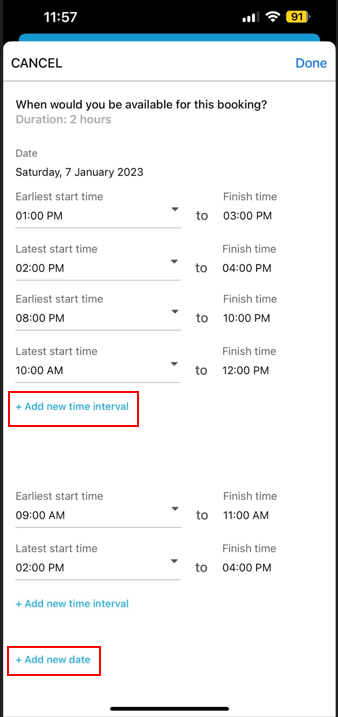
- Instant alerts: Admins receive push/email/SMS with the decline code, comments, and the suggested times, deep‑linking to the booking.
- Offer to customer: The suggested times can be sent to the customer by email/SMS with a secure link to confirm—speeding self‑service rescheduling and reducing churn.
- Rebook or re‑broadcast:
- If the customer accepts a suggested slot, update the appointment and keep the same tech.
- If the times don’t suit, admins can re‑broadcast to all matched, available fieldworkers; with Automatic Assignment, the first qualified accept is re‑assigned automatically.
- Records & analytics: Every response is stored on the booking (Activity / Job Requests) and in reports, so you can track top refusal causes and recovery rates.
- Works with Real‑Time Availability: Suggestions respect live calendars; availability checks prevent offering impossible times.
Configure it
- Path: Settings → General Settings → Forms & Checklists → Decline booking request form → Edit. The form is preconfigured; you can edit question text, make the reason mandatory, and toggle Reschedule Assist on specific options (e.g., Requested time not suitable).
- Assign when it appears: Use Assign to Status (e.g., Decline Job Offer, Withdraw From Scheduled Appointment) and Assign to Service to limit to relevant services.
- Notifications: Manage channels and messaging under Notifications & SMS; customer comms for declined/changed bookings can be customised per policy.
Edge cases & controls
- Automatic Assignment: If an already‑assigned tech later declines, the booking returns to Pending and the system re‑broadcasts to matched fieldworkers; you may also notify the customer automatically via Settings → General Settings → Job Assignment → Notifications for Declined Bookings.
- Manual Assignment: Multiple techs may accept; you choose the best candidate. If a chosen tech declines, use the captured alternatives to rebook, or send a fresh request to the pool.
- Admin override: Authorised staff can accept/decline/pend on behalf of a fieldworker; all actions are logged for audit.
Why enable it
Teams that capture alternate times at the point of decline recover a high share of at‑risk bookings, cut same‑day cancellations, and lift CSAT by giving customers immediate, convenient choices.
How job‑request status updates
OctopusPro updates request status in real time for both admins and fieldworkers:
- Pending → Accepted when a tech taps Accept.
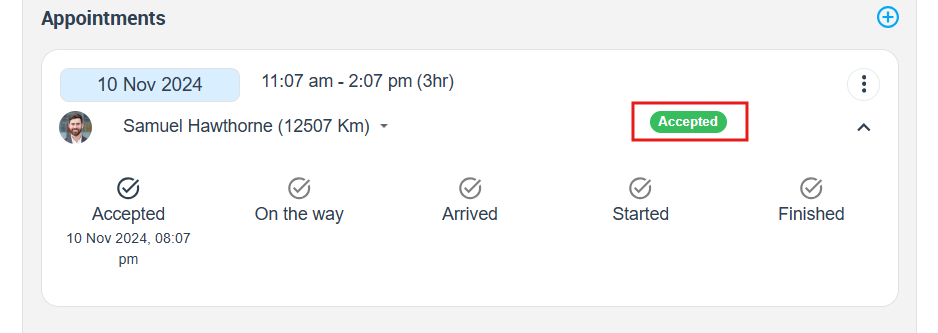
- Pending → Declined when a fieldworker submits the decline form (reason and, if enabled, alternate times).
- Assigned → Pending when an already‑assigned fieldworker declines under Automatic assignment; the system re‑issues the request to all matched fieldworkers. Office is notified, and—if enabled—customers are notified too. Path to toggle customer notice: Settings ▸ General Settings ▸ Job Assignment ▸ Notifications for Declined Bookings.
Statuses are visible on the booking Details page in Available fieldworkers, and in the calendar/status filters.
Notifications and booking details delivered to fieldworkers
Fieldworkers receive requests via push notifications (app), with SMS and email as configurable fallbacks. Notifications include job type, date/time window, duration, and mapped location. For privacy, the full booking address and contact details are hidden until the request is accepted, unless you enable Display the full booking address to fieldworkers at all times in Fieldworker Permissions. You can also enforce acknowledgement using the Pending‑Booking Accept / Decline Alarm, which prompts every five minutes until the fieldworker responds.


Fieldworkers can also review offers in the app under Bookings ▸ New Requests / Notifications, open the booking card, and then Accept or Decline.
Viewing pending job requests as a fieldworker
- Where to find them: In the fieldworker app, open Bookings ▸ New Requests to see every offer waiting for your response. Each card shows the service type, scheduled date/time, duration, and location. Tap a request to open full details.
- Respond fast: From the job card, tap Accept to confirm or Decline to refuse (you may be asked for a reason, and—if enabled—to suggest alternate times). Your choice updates the request status in real time for you and the office.
- Notifications you’ll receive: New requests arrive by push notification (and, if configured, SMS/email). If the Accept/Decline Alarm is enabled, the app can prompt you until you respond.
- Address privacy: Until you accept, customer contact details and the full street address may be hidden. Admins can allow full address visibility when required.
- Status keys you’ll see: Pending (awaiting your action), Accepted, Declined, and Assigned (confirmed to a fieldworker). Filters in the calendar and booking views let the office track these states.

If you don’t see a request you were expecting, check Notifications in the app and pull to refresh the New Requests list.
Job Assignment methods: Automatic vs Manual
How administrators assign jobs to fieldworkers
A. Choose your assignment mode
- Automatic assignment – The request is broadcast to all matched fieldworkers; first to Accept is assigned automatically. If the assignee later declines, the booking returns to Pending and the system re‑broadcasts to matched fieldworkers. Customer notifications on such declines are controlled by the Notifications for Declined Bookings toggle.
- Manual assignment – Multiple fieldworkers may Accept; each shows as Accepted but the booking remains unassigned until an admin clicks Assign job on the preferred candidate. If the chosen fieldworker later declines, the booking is flagged Declined for that fieldworker and you can Send job request again or Assign job to a backup.
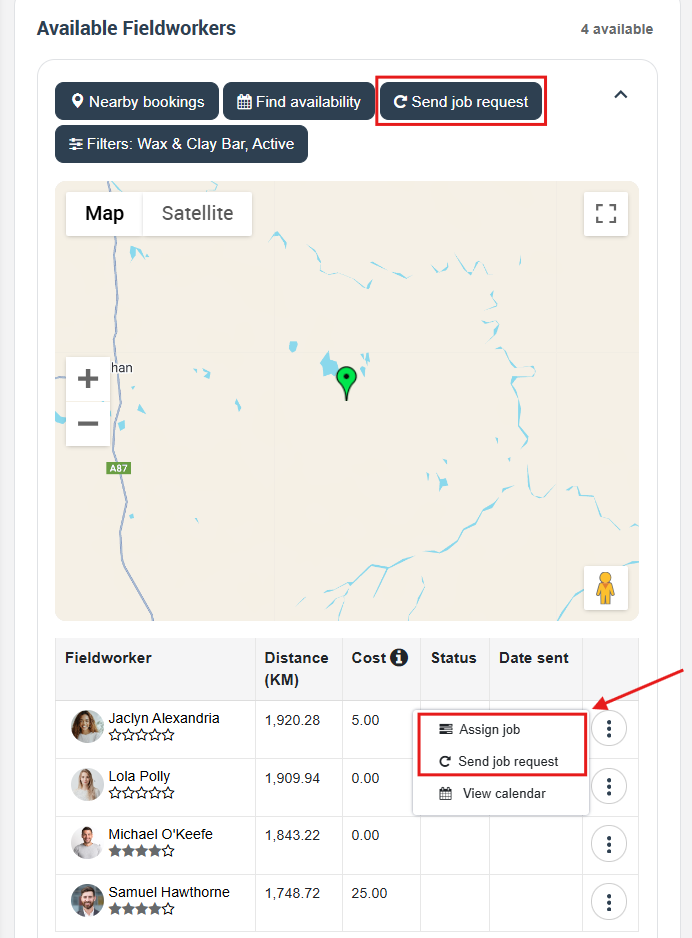
Set the mode: Settings ▸ General Settings ▸ Job Assignment.
Tip: Pair either method with Real‑Time Availability so requests go only to workers who are actually free. Path: Settings ▸ Customer Portal ▸ Flags & Permissions ▸ Enable real‑time availability.
B. Assign from the booking you’re viewing
Use this when a booking already exists.
- Open the booking → scroll to Available fieldworkers.
- Click Send job request.
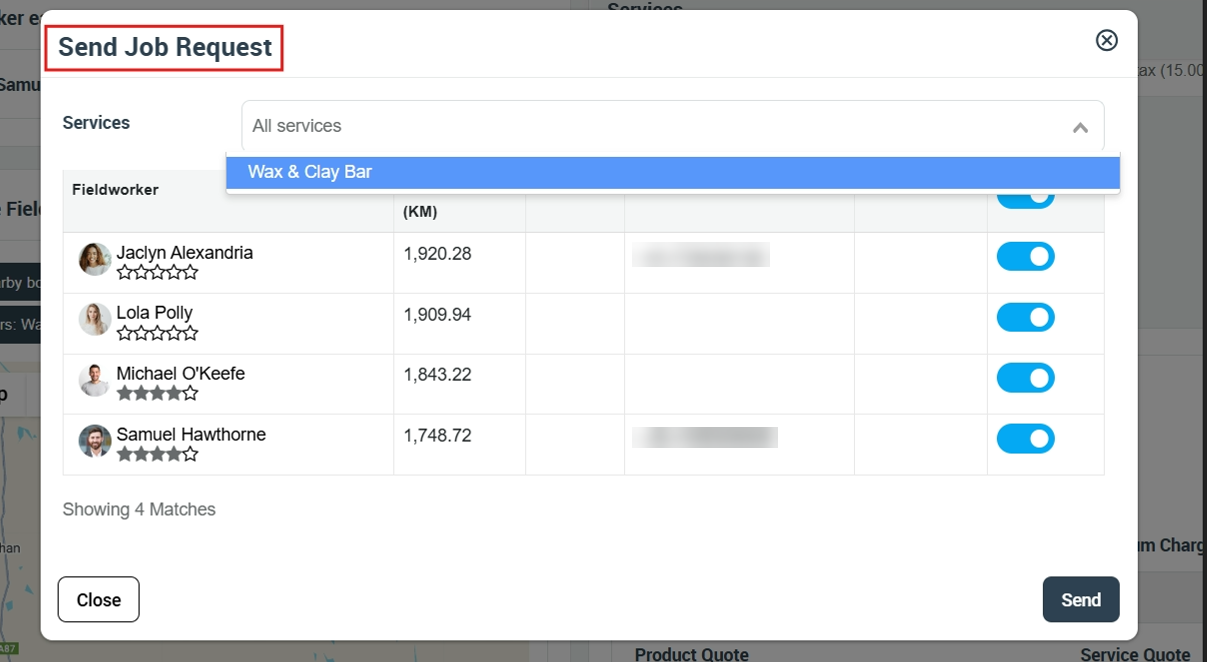
- In the popup, filter candidates by service, date/time, skills/tags and other match rules, then send.
- Manual mode: when responses arrive, click Assign job beside your preferred fieldworker.
- Automatic mode: the first Accept is assigned and the others see it as taken.
Admins can also resend to all available & matching fieldworkers from the booking overview if the first attempt fails.
C. Assign while creating a new booking
Use this for phone bookings or back‑office scheduling.
- Bookings ▸ Create new → add the Service.
- In Scheduled appointments, choose a fieldworker from the dropdown of available & matching fieldworkers (filters apply).
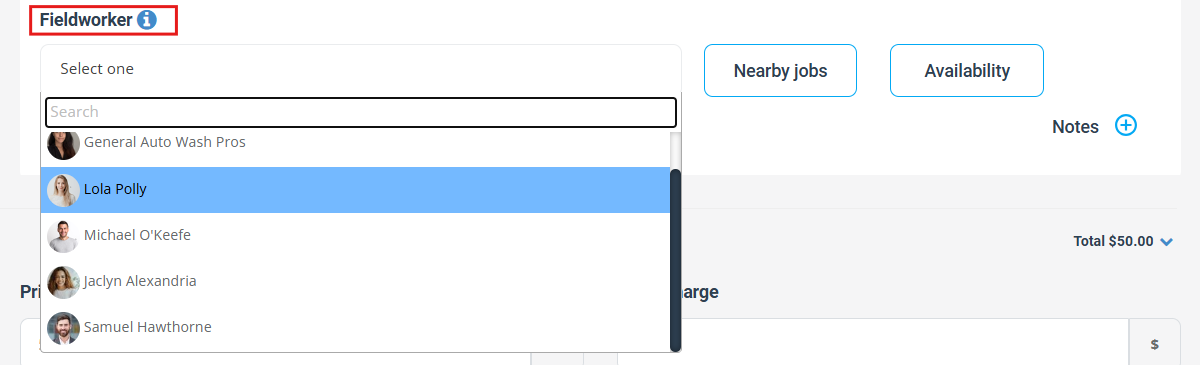
- Save. The fieldworker is notified via app push, SMS and/or email per their preferences.
D. Let the platform pre‑filter with Real‑Time Availability
Turn this on to check live calendars before any request is sent, avoiding pings to unavailable staff and speeding confirmations.
- Enable: Settings ▸ Customer Portal ▸ Flags & Permissions ▸ Enable real‑time availability.
- The engine matches skills, location/service area and live availability to compile the eligible list.
E. Visibility & notifications
- Fieldworkers receive job details via push/SMS/email and can Accept or Decline (if the permission is on).
- Admins can permit or prevent fieldworkers from accepting/declining via Settings ▸ General Settings ▸ Fieldworker Permissions ▸ Allow fieldworkers to accept and decline booking requests. If disabled, requests are auto‑accepted.
Flexibility in complex bookings
- Per‑service / per‑appointment control – A booking can contain multiple services or time slots. Fieldworkers may accept some and decline others, allowing the office to allocate remaining items to different fieldworkers.
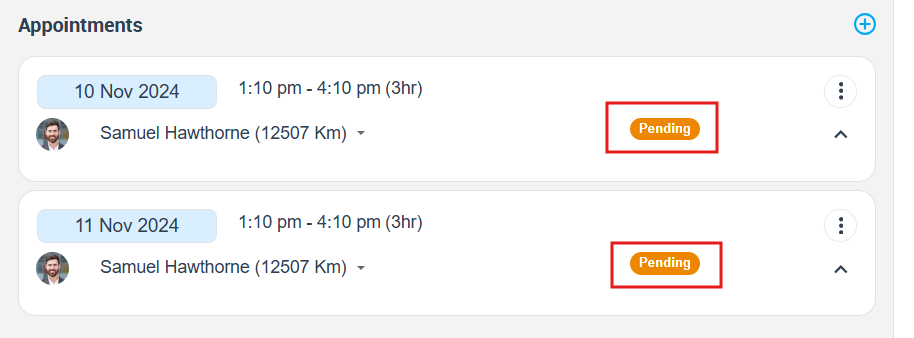
- Suggest alternate times – When declining, fieldworkers can submit alternative availability so the customer can keep the same preferred fieldworker.
- Multiple fieldworkers on one booking – For large jobs, you can assign more than one fieldworker and schedule separate appointments.
Conflict handling (quick reference)
| Scenario | System behaviour | What you (admin) need to do |
|---|---|---|
| Several fieldworkers tap Accept — Manual Assignment | Each responder’s status changes Pending → Accepted, but the booking remains Unassigned until you choose one. Others stay listed as Accepted candidates. | Open the booking → Available fieldworkers → review the Accepted list → click Assign job for your preferred technician; the rest are automatically released. |
| Several fieldworkers tap Accept — Automatic Assignment | The first qualified Accept is assigned and added to that fieldworker’s calendar. Later attempts see an “already assigned” message.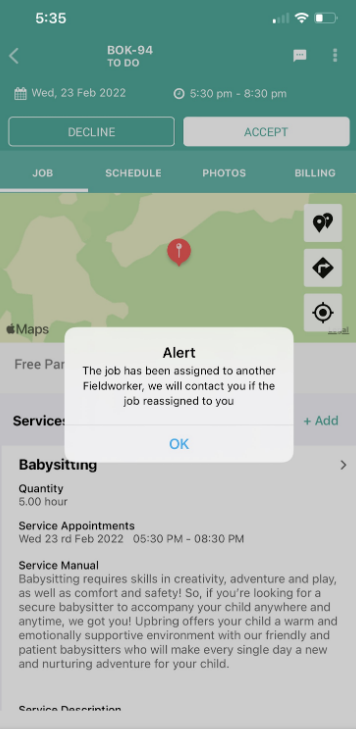 |
No action required; dispatch is complete. You’ll see the winner on the booking and calendar. |
| Assigned fieldworker declines — Automatic Assignment | The booking flips back to Pending, and OctopusPro re‑broadcasts the request to all matched fieldworkers so the first‑to‑accept loop runs again. Office is notified; customers can also be notified automatically if the Notifications for Declined Bookings toggle is enabled (Settings → General Settings → Job Assignment). | Monitor responses. If needed, manually Assign job from Available fieldworkers. Decide whether to keep customer notifications on or off based on your policy. |
| Assigned fieldworker declines — Manual Assignment | The job is removed from that fieldworker’s calendar and marked Declined for them on the booking. Admins receive an alert.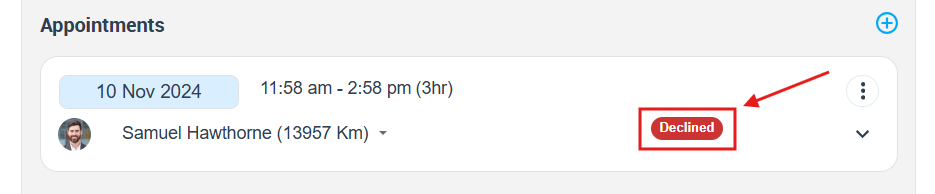 |
From Available fieldworkers, either Send job request (poll all matches again) or directly Assign job to a backup technician. |
Tip: If you require fieldworkers to propose alternate time slots when they decline, customers get immediate options and you keep the preferred tech where possible; otherwise the job continues through automatic re‑assignment.
Administrative features
View job‑request status (per booking)
From the booking Details page, scroll to Available fieldworkers to see every eligible fieldworker and their current request status — Pending, Accepted, Declined, Assigned — plus quick actions to Send job request or Assign job.
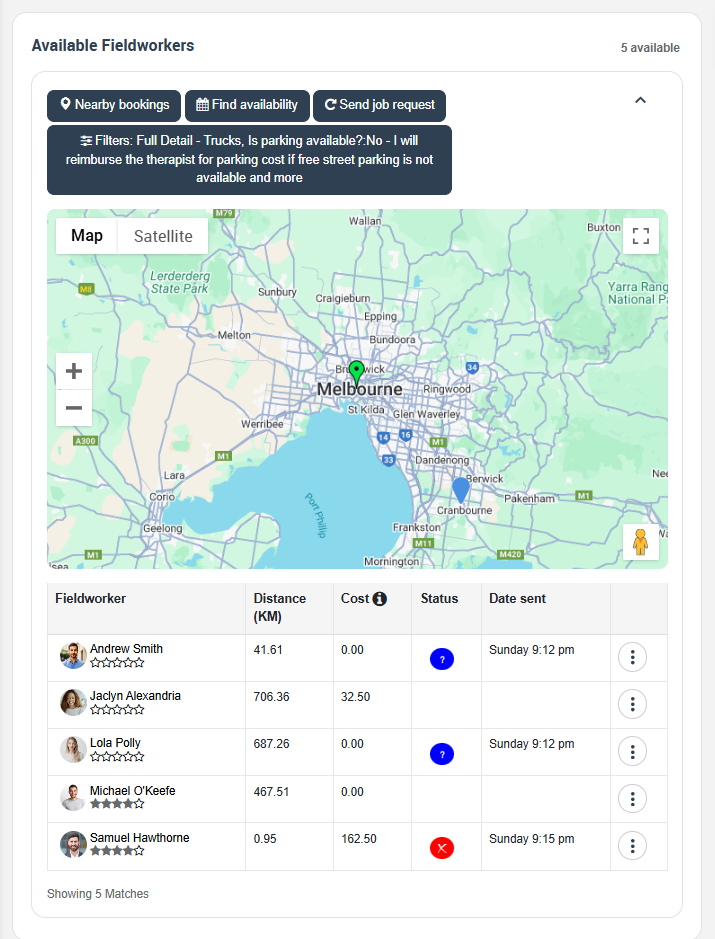
Tip: Use the Send job request popup to filter candidates by service, date/time and other match rules, then dispatch to one or many fieldworkers.
Track notifications & alerts
OctopusPro issues real‑time push, email, and/or SMS alerts when requests are sent, accepted, or declined, so dispatch can react before customers are impacted. You can also enable the Pending‑Booking Accept / Decline Alarm to force acknowledgement and log responses for audit.
- Customer updates when an assigned fieldworker declines: toggle Notifications for Declined Bookings under Settings ▸ General Settings ▸ Job Assignment to automatically notify (or deliberately not notify) customers when an already‑assigned fieldworker backs out.
Customize the decline‑reason form (preconfigured & fully editable)
OctopusPro ships with a pre‑built “Decline booking request” form, so you can start collecting structured reasons immediately. Admins can edit every part of it—questions, answer options, visibility, when it appears, attachments, and analytics—without code.
Where it lives
Settings › General Settings › Forms & Checklists → Decline Booking Request Form → Edit.
What’s included by default
- One mandatory multi‑select checkbox question: “Why are you declining this job request?”
Default options include: Requested time not suitable; Address outside my service area; I don’t hold the required licence/certification; Needed parts/equipment unavailable; Safety concerns at the job site; Scope/information unclear; Customer not responding; Personal emergency/illness; Other – see notes. You can rename, add, delete, or reorder any option.
- A comment field for extra context (e.g., “confined‑space permit required”).
- Visibility defaults to Fieldworker & Office. Display at is preconfigured for both Decline Job Offer (not yet assigned) and Withdraw From Scheduled Appointment (already assigned) so you capture reasons in either scenario.
Reschedule Assist (alternate time suggestions)
You can tie Fieldworker Reschedule Assist to specific decline reasons—e.g., turn it on for Requested time not suitable. When a fieldworker selects that option, the form prompts them to propose alternative time slots. Those suggestions are included in the admin alert and can be sent to the customer; the job can also be re‑broadcast to matched fieldworkers until one accepts. This reduces same‑day cancellations while preserving the customer’s preferred technician when possible.
Photos & evidence (optional)
Enable Show upload photos? and, if needed, Are photos mandatory? to require on‑site evidence (e.g., unsafe conditions).
Assign where it appears
Use the right‑hand actions to Assign to Status (so the form only appears at specific booking statuses) and Assign to Service (limit to relevant services). If you don’t assign, the form is available across all statuses/services.
Alerts & logging
- Submissions trigger real‑time push/email/SMS to dispatch with the fieldworker name, booking ID, decline code, timestamp, and comments, deep‑linking back to the booking.
- Responses are archived on the booking and in reports:
- Booking › Activity › Job Requests for a chronological view and quick filtering/export.
- Reports › All Booking Reports › Forms & Checklists Summary for heat‑maps, pies, CSV export, and scheduled digests.
Publish instantly
Click Save—changes are live immediately in the app; no mobile update required.
General editing help
Any default or custom form can be edited from Settings › General Settings › Forms & Checklists; you can also deactivate or delete forms (system defaults may be deactivated but not deleted).
Why this matters
Structured decline data powers better dispatch rules, targeted training, safer work practices, territory tuning, and faster re‑booking—teams that consistently track reasons report shorter reschedule cycles and higher acceptance rates.
Check availability before you offer or confirm
Use these tools to avoid sending requests to unavailable staff and to lock in realistic times:
- Dynamic Fieldworker Real‑time availability — system checks live calendars and only offers slots a matched, available fieldworker can service. Enable from Customer Portal ▸ Flags & Permissions.
- Fieldworker Availability Finder (schedule assistant) — an AI‑assisted planner that ranks the best‑qualified, nearest, soonest‑available fieldworker for the job.
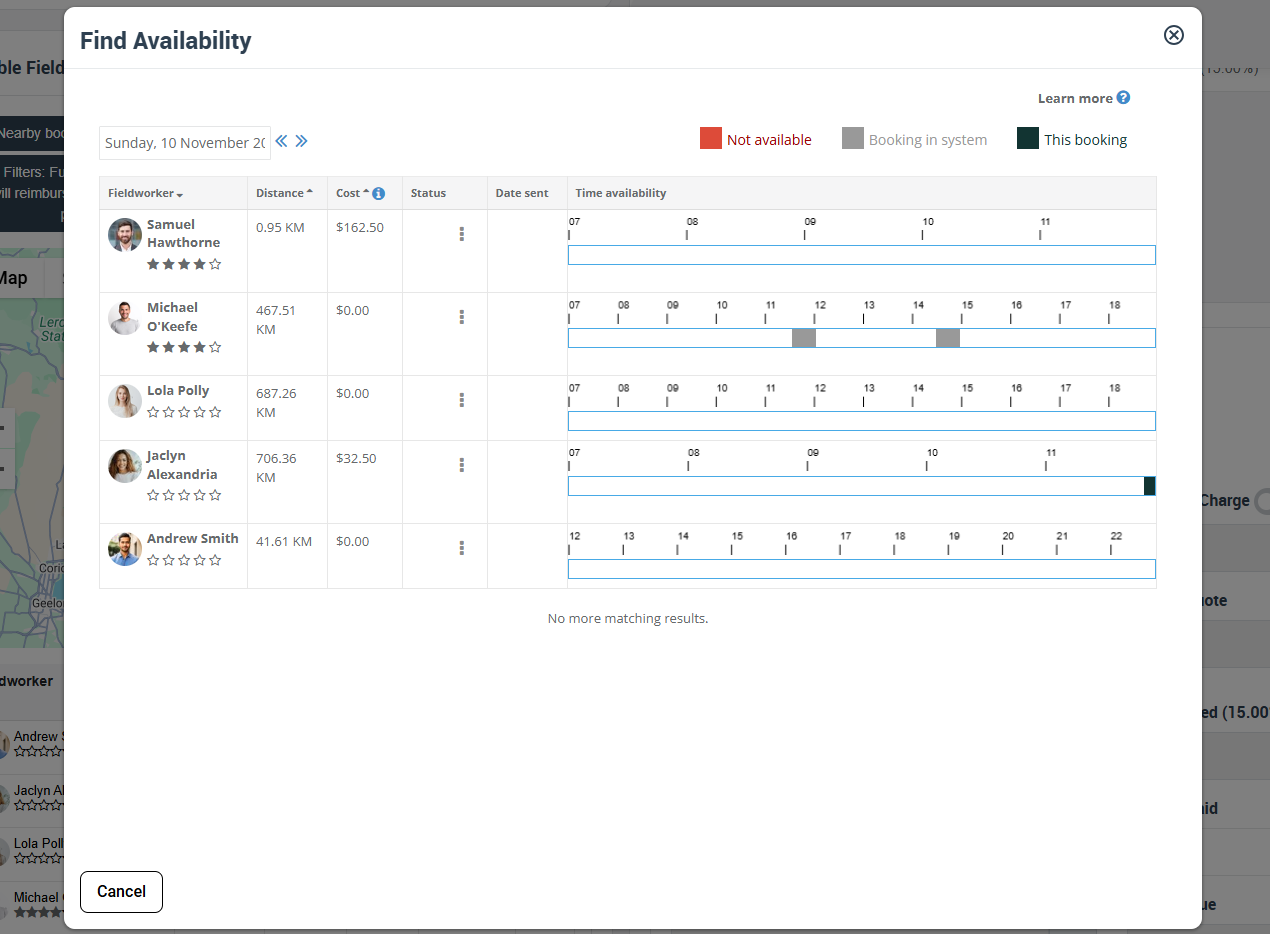
- Working hours & leave management — keep rosters accurate so availability and matching remain reliable.
Control address & contact visibility
By default, customer contact details and the full booking address are hidden until a request is accepted. If required, you can show the full address up‑front via the Display the full booking address to fieldworkers at all times permission. Related options also control general customer‑detail visibility.
Related features
- Fieldworker Availability Finder (schedule assistant) — AI‑assisted planner that ranks the best‑qualified, nearest, soonest‑available fieldworker for any job.
- Job assignment & dispatch methods — Configure Automatic (first‑accept wins) or Manual assignment, timeouts, re‑broadcasts, and edge‑case behaviours.
- Dynamic real‑time fieldworker availability — Check live calendars before offers are sent; can be disabled per booking when needed.
- Pending‑Booking Accept / Decline Alarm — Full‑screen prompt plus reminders every 5 minutes until the tech confirms or refuses; prevents “ghost” jobs.
- Fieldworker Reschedule Assist (alternative time suggestions & auto‑rebooking) — On Decline, collect alternate slots, notify the customer, and re‑broadcast to matched techs until one accepts.
- Custom Fieldworker Job Decline Reason form — Preconfigured, fully editable form to capture structured reasons, require photos, and drive analytics; supports Reschedule Assist.
- Display full booking address to fieldworkers — Control whether the full address shows only after acceptance or always; includes “On the Way” behaviour and ETA.
- Fieldworker permissions — Master list of flags controlling accept/decline, customer visibility, editing rights, photo requirements, and more.
- Fieldworker working hours & availability management — Maintain rosters, shifts, and leave to keep real‑time availability accurate.
- Admin override of booking requests — Dispatchers can accept, decline, or revert on behalf of a fieldworker; every action is logged for audit.
- Allow fieldworkers to accept & decline job requests — The permissions guide for enabling autonomy, notifications, and behaviours discussed on this page.
- Fieldworker app – handling job requests — Fieldworker‑facing guide to viewing, accepting/declining, and managing requests on mobile.
- Customer portal – minimum time before cancel — Enforce lead‑time rules for cancellations/reschedules made by customers.
- Alarms, ETA alerts & booking reminders — Configure previous‑day confirmations, drive‑time alerts, and other reminders alongside the Accept/Decline alarm.
To stay updated, please subscribe to our YouTube channel.
[/vc_column_text][/vc_column_inner][/vc_row_inner][/vc_column][/vc_row]